

Vol.90
August
KOR
NEWS

ETRI’s Top News

NEWS 1
ETRI Brings AI to Public Policy...International Standard for Policy Intelligence Finalized

- Policy Intelligence Combining Public Data and AI Secures ITU-T Final-Approved Standards Framework
- Presents Core Technology for Realizing Digital Government Through Linkage of Public and Private Data
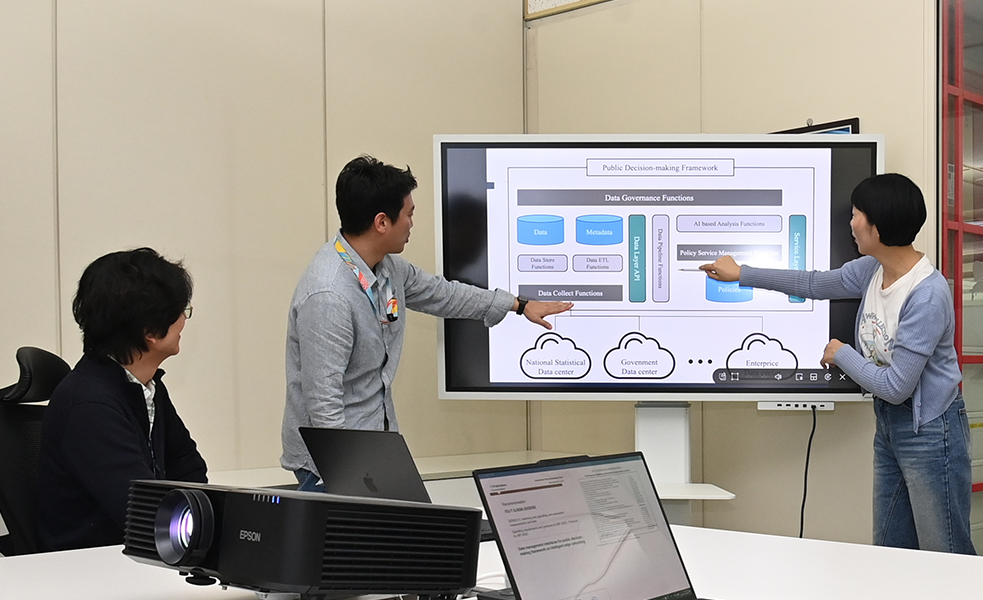
Korean researchers have secured leadership in the global standardization race by completing an international standard in the field of AI-based “policy intelligence1)Policy intelligence: An intelligent technology based on analysis, prediction and evaluation that combines public data and AI to support policy decision-making. It is a decision-support system that systematically analyzes policy effects and compares alternatives.” that supports public decision-making. With the official adoption of the AI- and data-based policy decision-making framework standard2)Policy decision-making framework standard: A standards framework that standardizes data collection, management and use procedures and components in the process of policy formulation, implementation and evaluation. It is a common specification for interoperability among institutions and consistent implementation of policy intelligence., it is seen as having established a key foundation for implementing digital government3)Digital government: A government operating system that innovates administrative services and advances policy operations based on data and digital technologies. It is an advanced e-government concept that improves the efficiency, transparency and connectivity of public services..

ETRI announced that the AI policy intelligence standard for supporting public decision-making, which it had promoted at the International Telecommunication Union Telecommunication Standardization Sector (ITU-T)4)International Telecommunication Union ITU-T: A standardization sector within the International Telecommunication Union (ITU) that develops international standards (Recommendations) in the telecommunications field. It is an international organizational system that discusses and approves global telecommunications and ICT standards. Protocols and Test Specifications Study Group (SG11)5)Protocols and test specifications Study Group (SG11, Study Group 11): A study group within ITU-T that standardizes signaling and control procedures (protocols) and test specifications for telecommunications services. It is a standardization organization that drafts Recommendations and conducts technical reviews. meeting held in Geneva, Switzerland, from March 3 to 11, received final approval6)Final approval (Recommendation): The final approval stage in ITU-T at which a standards document is adopted as an official Recommendation. It is a standards document officially recognized as an international standard and used as a reference by member states and industry. and was officially adopted as an international standard (Recommendation7)Recommendation: An official standards document that receives final approval from ITU-T and is adopted as an international standard. It is a standard specification used as a reference by member states and industry in the telecommunications and ICT fields.).

The newly approved standard is the “Data Management Interfaces for a Public Decision-making Framework on Intelligent Edge Computing8)Intelligent edge computing: A distributed computing technology that uses AI to analyze and process data in real time in the field (at the edge) rather than on a central server. It is a processing method that reduces latency and enables immediate policy response. (ITU-T Q.5036)” and its core purpose is to define the data management structure, interfaces9)Interface: Connection standards and interoperability methods for exchanging data between systems. It is a set of interface rules that allow different institutions and systems to be linked in the same way., and data exchange rules (protocols)10)Data exchange rules (Protocol): Communication rules that define data transmission formats, procedures, error handling and other matters between institutions and systems. It is a set of exchange rules that ensure data compatibility and interoperability. for implementing AI-based policy intelligence.

ETRI researchers proposed the standard on the international stage and had it adopted as a new standard, then led it through final approval, achieving the completion of an international standard in the field of public policy intelligence.

This is significant because it went beyond a simple technology proposal and was adopted as an internationally recognized standard, demonstrating both the technology’s maturity and its reliability.

The standard includes a data management structure that systematically integrates and manages the diverse social and economic data needed for public policy decision-making and supports its use in AI learning and policy analysis.

In particular, it comprehensively defines a “data pipeline11)Data pipeline: A processing flow and automated procedures that run from data collection → cleansing → storage → analysis → use. It is a processing system that connects data so it can be used for policy analysis and AI training.” that connects the entire process from data collection to storage, analysis and use; a “workflow” that automates policy implementation procedures; and a “data governance12)Data governance: An operating framework for managing data quality, security, permissions, standards and principles of use. It is a management standard and a responsibility structure for reliable use of data.” system that ensures data security, quality and usability.

It also laid the foundation for the efficient development and operation of policy intelligence services by presenting standard interfaces that securely link distributed public and private data and enable data use across stakeholders.

Previously, there were difficulties in integrating and utilizing public data due to varying management systems and security policies across different stakeholders. As a result, practical application of AI-based policy decision-making technologies has also faced limitations. To address these issues, this standard is characterized by presenting a data framework structure and management interface in an internationally unified manner.

In particular, this standard is based on “intelligent edge computing.” This technology analyzes and processes data in real time in the field or on distributed devices rather than on a central server, dramatically increasing the speed of policy response. It enables real-time data-based decision-making in various areas, including disaster response, economic situation analysis, and transportation and environmental policy.

Recently, as demand has grown worldwide for digital government implementation and AI-based policy decision-making, the importance of policy intelligence technology that combines public data and AI has been rapidly coming to the fore. In particular, the need for data-based decision-making is increasing in complex policy areas such as national fiscal management, economic policymaking and social system analysis, and demand for standardization to support it is also continuing to grow.

With the completion of this international standard, ETRI has established itself as a key institution leading global standards in the field of AI policy intelligence for public decision-making. In addition, as the standard enables the linkage and shared use of policy data between countries, it is expected to further expand the foundation for international cooperation.

Lee Yeonhee, head of ETRI’s Policy Intelligence Research Center, said, “The completion of this international standard is the result of global recognition of AI policy intelligence technology for public decision-making,” adding, “We plan to actively promote the spread of policy intelligence technology and international cooperation going forward.”

Principal Researcher You Taewan also emphasized, “AI- and data-based policy decision-making technology is a core element in implementing digital government,” adding, “Based on the international standard, it will make a major contribution to public service innovation and improved policy efficiency.”

This achievement was produced through the “Development of Financial and Economic Digital Twin Platform Based AI and Data” research project, carried out with support from the Ministry of Science and ICT (MSIT) and the Institute of Information & Communications Technology Planning & Evaluation (IITP), and ETRI’s basic research project, “Development of AI and Big Data-Based Policy Intelligence Technology.”

You Taewan, Principal Researcher
Policy Intelligence Research Center
(+82-42-860-0642, twyou@etri.re.kr)
NEWS 2
ETRI Leads International Standard for AI-Based Frequency Prediction Technology

- Achieves Approval of New ITU-R Report After Leading International Discussions for 7 Years
- Presents Data-Based Spectrum Management Methodology for the AI and 6G Era

A machine learning-based methodology developed by Korean researchers to assess and predict frequency availability has been recognized as a new reference methodology in the international field of spectrum management. This is a valuable achievement in which international standardization discussions proposed by Korea have borne fruit after seven years, and it is significant in that Korean researchers led every step of the process, from the standardization proposal and technology development to international discussions and final approval.

ETRI announced that, at the International Telecommunication Union Radiocommunication Sector (ITU-R)1)ITU-R: The International Telecommunication Union (ITU) is an international organization responsible for the international allocation of radio-frequency spectrum and the standardization of information and communication technologies, and it has the Spectrum Management Study Group (SG1) under its Radio Communication Sector (ITU-R). The Radio Communication Sector (ITU-R) develops international recommendations and standards related to radiocommunications and spectrum management. Spectrum Management Study Group (SG1) meeting held in Geneva, Switzerland, from June 3 to 11, the new ITU-R Report developed by its researchers, 「Methodologies for Assessing or Predicting Spectrum Availability2)Spectrum Availability: The extent to which spectrum resources are available for wireless services in a particular area and at a particular time.」 was approved.

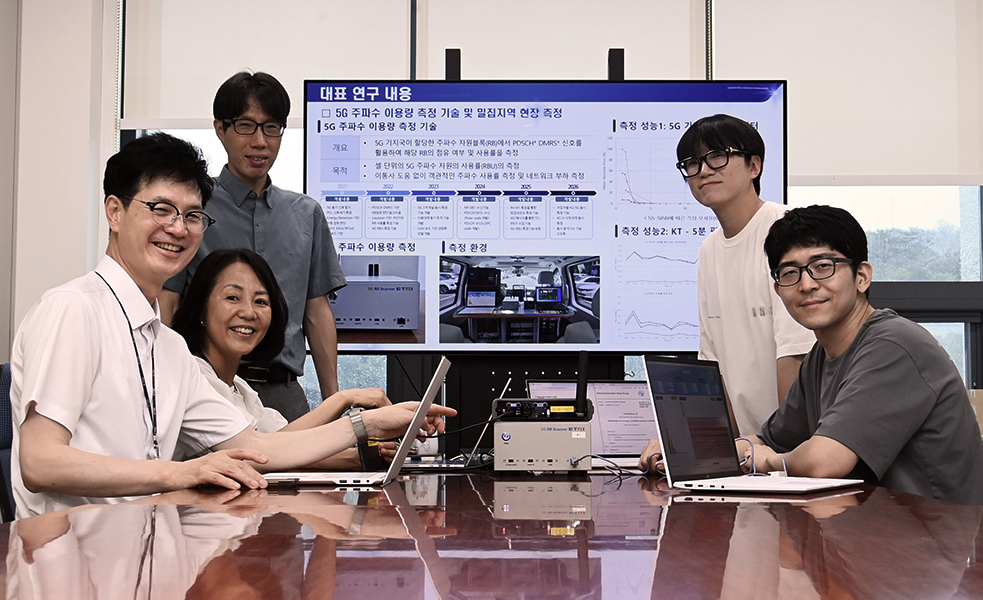
The Report describes methods for using the AI technology known as machine learning to assess and predict how much frequency can be used in a particular area and at a particular time. The Report was written based on ETRI’s machine learning-based spectrum availability assessment and prediction technology, which was published in an SCIE-level3)SCIE-level: An SCIE-level international journal (Science Citation Index Expanded) refers to a journal listed in Web of Science, a globally authoritative academic database in science and technology provided by Clarivate of the United States. international journal, and is expected to be published as an official new Report after ITU-R’s final editing process.

Spectrum availability refers to the extent to which frequency can be used for wireless communications in a particular area and at a particular time. As next-generation wireless services such as AI services, 6G mobile communications and low orbit satellite communications have recently expanded rapidly, demand for frequencies is also increasing, making assessment and prediction technologies for efficiently using frequencies increasingly important.

ETRI has steadily researched technologies for assessing and predicting spectrum availability using actual mobile communications frequency usage data. It has been recognized for its technological capabilities by developing technologies to assess the balance between frequency demand and supply in LTE networks and machine learning-based LTE frequency usage prediction technologies, which were published in SCIE-level international journals.

Based on these research achievements, ETRI developed a spectrum availability assessment and prediction methodology that can be used internationally, and it was reflected as the core content of the new ITU-R Report. Going forward, this methodology is expected to be used as an international reference technology in areas such as ▲establishing measures to improve AI-based frequency use efficiency ▲introducing data-based spectrum management ▲developing frequency supply strategies for the 6G era.

This achievement is the result of seven years of international standardization activities. ETRI began discussions in 2019 by proposing a new ITU-R Question (a formal study item) for the development of a new Report, and in 2021, it proposed a draft Report based on related research achievements, leading to its adoption as a working document. Since then, it has led the development of the new Report by submitting revised contributions every year and succeeded in securing final approval of the new Report after reaching an international consensus by reflecting cases from China, Brazil, Indonesia, India and other countries.

Seungkeun Park, Principal Researcher of ETRI’s Radio Research Division, said, “The approval of this ITU-R Report is a meaningful achievement in which the data-based spectrum management technology that ETRI has steadily pursued has been recognized internationally through ITU. We will continue to further advance intelligent spectrum management technologies using machine learning and data analysis so that frequencies needed for wireless AI communications can be supplied at the right time and in the right amount.”

Building on this achievement, ETRI’s Radio Research Division plans to further develop AI-based spectrum management technologies, including mobile communications traffic pattern prediction using AI, digital virtual cell-based frequency efficiency prediction and analysis of network capacity by mobile communications technology generation, and to continue participating in international standardization activities based on these technologies to further strengthen the global competitiveness of Korea’s data-based spectrum management technology.

This achievement was carried out through the Ministry of Science and ICT’s “Development of Technology for Securing and Supplying Spectrum Resources.”

Yoon Jonghun, Senior Researcher
Radio Resource Research Section
(+82-42-860-0813, jonghun.yoon@etri.re.kr)

NEWS 3
ETRI Opens Era of Infection-Free Midair Touch Interfaces

- Succeeds in Localizing a Core Component for Pseudo-holographic Midair Imaging Previously Monopolized by Japanese Suppliers
- Demonstrates a Contactless Interface for Controlling a Screen That Appears to Float in Midair
- Expected to Enable a Next-Generation UI That Reduces Contact-Related Infection Risks in Operating Rooms and Public Facilities

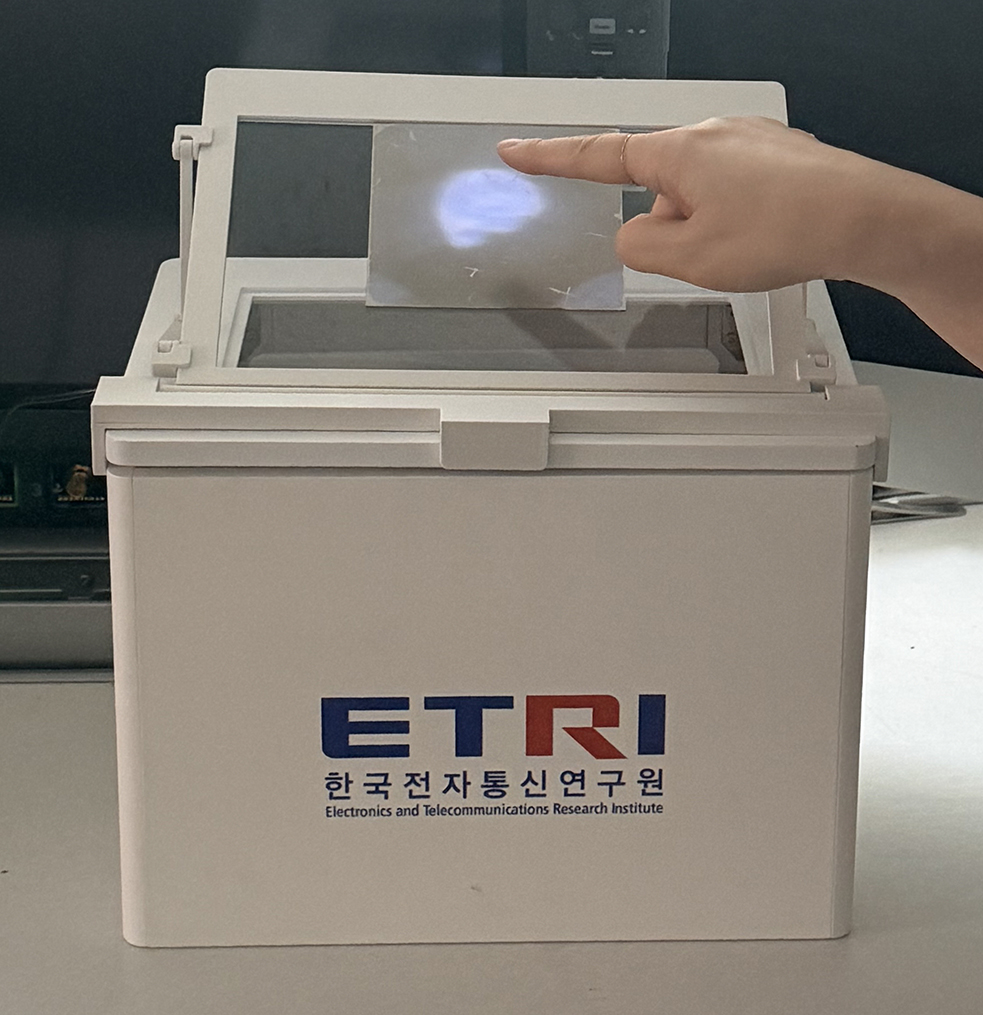
Korean researchers have successfully localized a core component for pseudo-holographic midair imaging1)Pseudo-holographic Midair Imaging: An optical technology in which light emitted from a hidden display, such as an LCD or LED, is precisely redirected through the microscopic reflective structures of a specially designed mirror reflector, creating an optical illusion that makes an image appear to float in midair. Unlike conventional holography, the technology does not use holographic interference or diffraction, yet allows midair images to be viewed directly with the naked eye without requiring special glasses or an additional screen. It can therefore overcome some of the limitations associated with conventional AR/VR devices, such as dizziness and spatial distortion. When combined with a spatial touch sensor, it can also be used as a contactless interface that allows users to interact directly with images or virtual buttons in midair. that had previously relied on exclusive supply from Japanese companies and demonstrated a contactless interface technology that allows users to directly control a screen that appears to float in midair. In the future, users will be able to operate devices in environments such as operating rooms simply by pressing virtual buttons in midair without touching a physical screen, paving the way for a new contactless touch environment that can help reduce the risk of infection caused by physical contact.

ETRI has developed, using its own domestic source technology, a core component for Pseudo-holographic Midair Imaging, an optical technology that uses an optical illusion to make images appear to float in midair.

The research team successfully localized a DCRA-based mirror reflector sheet (pseudo-hologram sheet)2)Mirror Reflector Sheet (Pseudo-hologram Sheet): A DCRA (Dihedral Corner Reflector Array) is an optical structure consisting of arrays of microscopic reflective structures that precisely control the propagation direction of incident light. A DCRA-based mirror reflector sheet is a key optical component for implementing Pseudo-holographic Midair Imaging. Japanese companies have manufactured and supplied related products to the global market using precision microfabrication technologies. that had previously been exclusively supplied by Japanese companies and also demonstrated a prototype contactless input/output device incorporating the component.

Pseudo-holographic Midair Imaging is an optical technology that precisely controls light emitted from a display through the microscopic reflective structures of a specially designed mirror reflector, creating an optical illusion in which images appear to float in midair. The midair images can be viewed directly with the naked eye without requiring special glasses or an additional screen. When combined with a spatial touch sensor3)Spatial Touch Sensor: A sensor that detects the position and movement of a user's finger within the area where a midair image appears. It enables contactless operation by recognizing touch gestures without requiring direct physical contact with a screen., the technology enables users to interact with images or virtual buttons in midair using their fingers, making it suitable for next-generation contactless user interfaces.

Currently, DCRA-based mirror reflector sheets, a core component of Pseudo-holographic Midair Imaging, are manufactured by Japanese companies using precision microfabrication technologies and supplied to the global market. With limited domestic manufacturing infrastructure for these components, Korea has largely relied on imported products.

To address this dependence, ETRI research team developed a proprietary process for fabricating high-resolution mirror reflector sheets using polymer materials4)Polymer material: A material composed of compounds with very high molecular weights, such as plastics. Compared with glass, polymer materials are lighter and easier to process, making them advantageous for low-cost mass production while also enabling flexible design and adaptation to a wide range of form factors., photolithography, and imprinting5)Imprinting: An ultra-precision fabrication technology that replicates microscopic structures by placing a material into or against a mold containing the desired micropatterns and repeatedly transferring the structures onto a target substrate, much like stamping or using a mold. Depending on the material and fabrication process, heat, pressure, or photocuring can be used, making imprinting suitable for the mass replication of microstructures. technologies.

Based on its proprietary source technology, the research team fabricated a 10 cm × 10 cm mirror reflector sheet and used it to develop a Pseudo-holographic Midair Imaging prototype in which images appear to float in midair. The technology was successfully demonstrated at the recently held WIS 2026 ICT Technology Exhibition Festival.

The technology can be applied to a wide range of contactless user interfaces, including surgical lesion-tracking monitors, glasses-free medical displays, contactless information systems in public facilities, elevator buttons, and in-vehicle displays.

In particular, demand for technologies that minimize direct contact with shared touchscreens has increased following the spread of infectious diseases such as COVID-19. The technology is therefore expected to have significant potential for use in medical institutions and multi-use public facilities.

Kim Joo Yeon, Principal Researcher at ETRI, said, “This achievement is significant in that we have developed, using our own domestic source technology, a core component for Pseudo-holographic Midair Imaging that had previously depended on overseas suppliers. Going forward, we plan to further advance integration with spatial touch sensors and improve the technological maturity to a level where users can interact more freely with midair images and visual content.”

This research was conducted with support from the Ministry of Trade, Industry and Energy under the Electronic Components Industry Technology Development Program, “Development and Demonstration of Display Technology for Creating New Markets.”

The research team plans to further develop spatial touch capabilities, conduct demonstrations at public institutions and multi-use facilities in Korea, and explore opportunities for global market entry through overseas exhibitions in the Middle East, the United States, and other regions.

Kim Joo Yeon, Principal Researcher
Regional Industry AX Research Section
(+82-31-739-7232, jooyeon.kim@etri.re.kr)