

FOCUS ON ICT
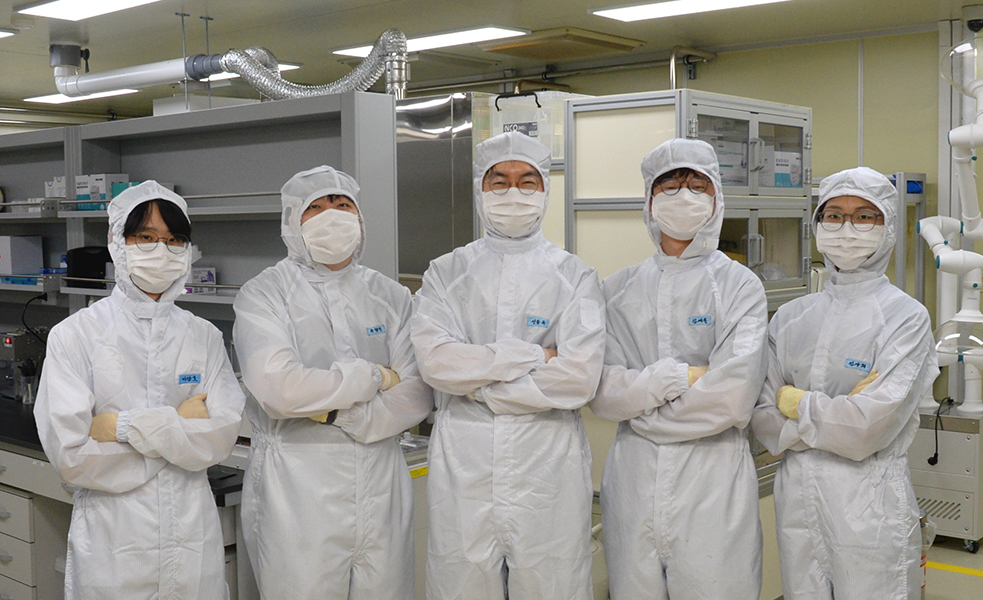
Korean researchers have successfully developed core technologies for both cathodes and anodes in the field of aqueous zinc-ion batteries1)Aqueous zinc-ion battery: A zinc-ion battery that uses a water-based aqueous electrolyte. It is considered advantageous for large-scale storage devices due to its high safety, low flammability, and relatively low cost., which are drawing attention as next-generation safe energy storage devices. By reducing performance degradation and significantly extending lifespan even during fast charging and discharging, this is expected to greatly accelerate the commercialization of next-generation batteries.
A joint research team from ETRI and Sungkyunkwan University said it has developed core cathode and anode material technologies that can simultaneously address output degradation, electrode structural damage and dendrite2)Dendrite: A phenomenon in which zinc metal grows into sharp, tree-branch-like structures during charging and discharging. If it grows repeatedly, it can cause internal short circuits and shorten battery lifespan. formation, which have been cited as chronic limitations of aqueous zinc-ion batteries.
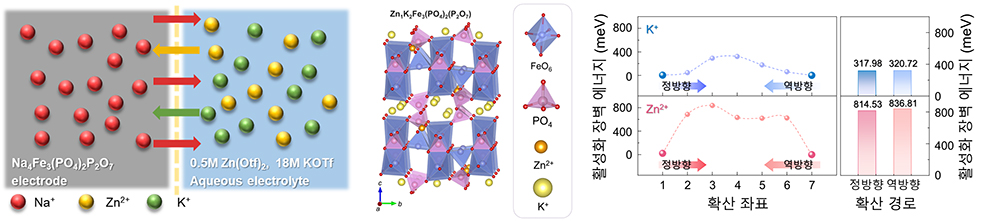 Cathode fabrication process via ion exchange (left), crystal structure of the dual-ion polyanionic cathode (center), and ion activation barrier energy at the cathode obtained from first-principles calculations (right)
Aqueous zinc-ion batteries, which use water-based electrolytes, are attracting attention as next-generation secondary batteries because they pose a lower fire risk and offer higher cost competitiveness than lithium-ion batteries. However, repeated rapid charging and discharging caused battery performance to drop sharply and electrode structures to be easily damaged. Furthermore, the occurrence of zinc dendrites during battery use has been a major obstacle to commercialization, as it causes internal short circuits, shortens lifespan, and leads to failures.
To address performance degradation in the cathode, the researchers first introduced a ‘dual-ion intercalation3)Dual-ion intercalation: Instead of using only zinc ions (Zn2+), potassium ions(K+)also enter and exit the cathode. It is a design concept that reduces the problem of performance degradation during fast discharge by allowing both ions to move together. structure’ in which potassium ions (K⁺) also participate in the intercalation reaction, moving beyond the previous approach in which only zinc ions (Zn2+) reacted independently.
Conventional zinc ions face high energy barriers when moving inside electrodes, limiting their mobility, whereas potassium ions can move relatively freely. By designing the electrode so that the two ions react together, the researchers reduced bottlenecks caused by ion aggregation and effectively reduced the battery’s output degradation and voltage loss even during high-rate charging and discharging.
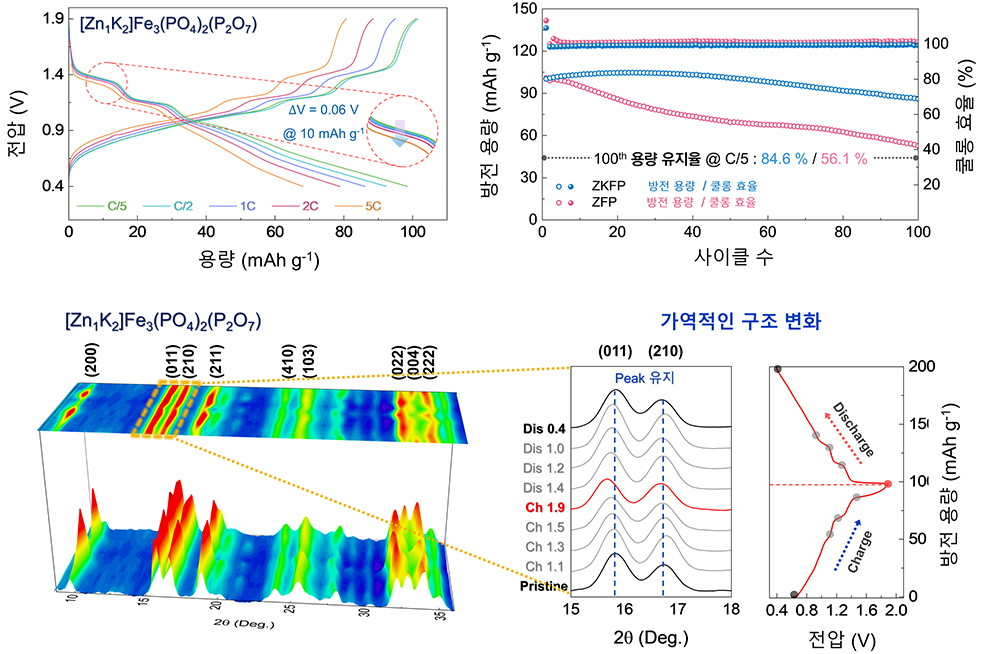 Rate capability of the developed cathode (top left), improved lifespan attributes with dual-ion incorporation compared to without (top right), and reversible structural changes of the cathode during charge/discharge (bottom)
In addition, they applied an iron-based polyanion4)Polyanion: A crystal structure with a strongly bonded structural framework, like the phosphate series. Because the structure is maintained relatively well even during repeated charging and discharging, it can be advantageous for lifespan. structure as the cathode material framework, designing the electrode structure to remain stable during charging and discharging. This greatly reduced structural degradation caused by repeated use and improved long-term lifespan characteristics.
The researchers conducted performance evaluations under actual high-rate charge-discharge conditions and confirmed that power retention characteristics and long-term stability were significantly improved. They also used first-principles calculations5)First-principles calculation: A method for predicting how easily ions can move (migration barriers, etc.) through atomic- and electronic-level calculations. It is used to computationally support why the performance improvements observed in experiments are possible. to determine that potassium ions have a lower migration barrier in certain structures, providing a theoretical basis for the experimental results.
The researchers then developed zinc metal anode technology that solves the problem of uneven zinc metal growth, a longstanding challenge for anodes. Conventional aqueous zinc batteries suffer from zinc dendrite formation, in which zinc grows unevenly in needle-like forms during charging and discharging, leading to reduced battery lifespan and a risk of short circuits. They also generally use a structure with an excessive amount of thick zinc metal, which has the limitation of lowering the energy density of the overall battery.
To solve this, the researchers used a block copolymer6)Block copolymer: A polymer material in which polymer chains with different properties are connected. It can form regular nanostructures on its own, so it is used in precise nanopatterning processes. self-assembly process to create a new concept of a growth-directing nanostructured interface for zinc electrodeposition that combines an array of gold nano seeds (Au nano seed) with a reduced graphene oxide (rGO)7)Reduced Graphene Oxide (rGO): A carbon material with increased electrical conductivity, made by removing some oxygen components from graphene oxide. It is used to improve electron mobility and interfacial stability. nano layer.
The developed nanostructured interface uniformly guides zinc-ion migration and the initial nucleation8)Nucleation: The initial process in which metal ions first begin to precipitate in metallic form. Uniform nucleation is required for stable metal growth and electrodeposition. process, enabling flat, dense zinc growth and making it possible to fabricate thin zinc anodes. In particular, it fundamentally suppressed dendrite formation by controlling the growth direction of zinc into a stable form.
This anode technology operated stably even in long-term charge-discharge environments exceeding 3,000 hours and was shown to effectively suppress hydrogen evolution9)Hydrogen evolution reaction (HER): A side reaction in which hydrogen gas is generated during charging in a water-based electrolyte. It may cause electrolyte consumption and electrode degradation. and byproduct formation. In particular, the researchers demonstrated stable operation even under ultralow N/P conditions (N/P=2)10)N/P ratio: The capacity ratio between the negative electrode and the positive electrode. In general, aqueous zinc batteries use an excess amount of zinc and therefore have a high N/P ratio; the lower the ratio, the more advantageous it is for improving energy density., using only a minimal amount of zinc instead of thick zinc foil, achieving a high energy density of 156.1 Wh/kg
Sungkyunkwan University Professor Jongsoon Kim explained, “Performance degradation and structural deterioration during fast charging and discharging have been representative challenges for aqueous zinc batteries,” adding, “This study presents a direction for simultaneously improving rate capability and stability by stably implementing a dual-ion intercalation structure.”
Director at ETRI Shin Dong Ok said, “By controlling both the initial nucleation and growth direction of zinc metal through nanostructured interface design, we realized a stable, dendrite-free zinc anode,” adding, “We expect it can be effectively applied to next-generation aqueous secondary battery systems that require both high energy density and long lifespan.”
The researchers plan to further optimize electrolyte composition, electrode microstructure and cell design, and to verify practical applicability through pouch cell-based demonstration studies. Meanwhile, among these research achievements, the cathode material study was published in October 2025 in the international journal Energy Storage Materials11)Energy storage materials (IF: 20.2, top 4.7% in the field), in the field of energy materials, while the anode material study was published online in May 2026 in the international nanoscience journal Nano-Micro Letters12)Nano-Micro Letters (IF: 36.3, top 1.0% in the field).
ETRI’s Director Shin Dong Ok and Sungkyunkwan University Professor Jongsoon Kim participated as corresponding authors in both studies, and the researches were conducted with support from programs including the Creative Specialist Laboratory project, “Development of Core Technology for Next-Generation Aqueous Multivalent Metal-Ion Batteries Based on Non-Lithium Resources,” under ETRI’s Creative Challenge Bridge Investment Program.
Shin Dong Ok, Director
Future Electronics Convergence Materials Research Section
(+82-42-860-1024, doshin@etri.re.kr)