

FOCUS ON ICT
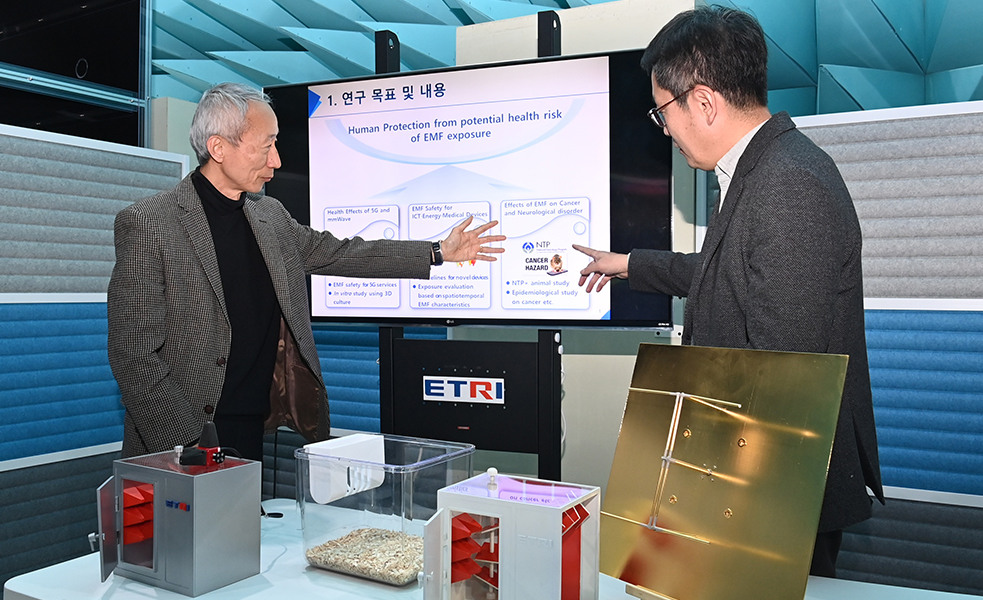
Electronics and Telecommunications Research Institute (ETRI) announced that a large-scale international collaborative animal study conducted with Japan found no statistically significant association between long-term exposure to radio frequency (RF)1)Radio Frequency (RF): Electromagnetic radiation in the frequency range used for wireless communication and telecommunication systems.
Note: In this context, RF refers to the range of 9 kHz to 300 GHz as defined by the ITU-R Radio Regulations. electromagnetic fields (EMF) emitted by mobile phones and the incidence of brain, heart, or adrenal tumors.
The study was designed to evaluate potential carcinogenic effects at exposure levels that form the basis of human safety guidelines for mobile phone RF electromagnetic fields and to scientifically verify the findings of the 2018 U.S. National Toxicology Program (NTP)2)National Toxicology Program (NTP): A U.S. interagency program operated by three government agencies under the Department of Health and Human Services (HHS), which evaluates the effects of environmental substances on human health. The NTP has assessed more than 2,800 substances and published over 600 carcinogenicity reports as of 2021. Its radiofrequency (RF) study was published in 2018., under the National Institutes of Health (NIH). The NTP study reported increased incidences of brain, heart, and adrenal tumors in male rats following lifetime exposure to 900 MHz CDMA3)900 MHz CDMA: A second-generation (2G) digital mobile communication technology operating in the 900 MHz frequency band, which allows multiple users to share the same frequency channel through code division multiplexing.-modulated RF signals at 6 W/kg4)Watts per kilogram (W/kg): A unit of specific absorption rate (SAR) that represents the rate at which electromagnetic energy is absorbed per unit mass of biological tissue.. The present study was also motivated by recommendations from international organizations, including the World Health Organization (WHO), which emphasized the need for further research to assess the reproducibility and validity of those findings.
In response, ETRI and Japanese research partners initiated the “Korea-Japan Joint Study on the Carcinogenicity and Genotoxicity of Mobile Phone RF Electromagnetic Fields” in 2019 and conducted a long-term international collaborative animal study using a cross-national data integration framework. This study represents the first attempt to integrate experimental data across countries in the field of toxicology regarding RF-EMF exposure.
 Duration and Procedure of RF Exposure in Animal Experiments
A key feature of this study is that it applied the same research framework as the NTP study and established a joint protocol based on OECD toxicology testing guidelines. The experiments were conducted under identical conditions, including the same animal model, feed, equipment, and RF exposure environments in both countries. Notably, reverberation chamber5)Reverberation chamber: A test facility used in electromagnetic studies that generates a statistically uniform and isotropic electromagnetic field within an enclosed space using mechanical or electronic mode stirrers. It enables whole-body exposure under controlled conditions and reduces stress on animals by allowing unrestricted movement during experiments.-based RF exposure systems developed by ETRI were installed in Korea and Japan, enabling parallel exposure control, dosimetry, and simulation under equivalent conditions.
The experiment consisted of three groups (RF-exposed, sham-exposed6)Sham-exposed group: A control group maintained under conditions identical to the RF-exposed group, including the use of the same exposure system, but without actual RF exposure. This design controls for environmental and experimental factors unrelated to RF exposure, allowing the specific effects of RF to be isolated through comparison with the RF-exposed group., and cage-control) with 70 male rats per group. Animals were exposed to 900 MHz CDMA-modulated RF signals at a whole-body specific absorption rate (SAR) of 4 W/kg from early gestation through 104 weeks. This exposure level corresponds to the value used as the basis for establishing international human exposure guidelines.
The study found that patterns of changes in body temperature, body weight, and food consumption associated with RF exposure were generally comparable between Korea and Japan. Food consumption tended to be slightly lower in the RF-exposed group than in the sham-exposed group. Survival analysis showed no statistically significant differences among groups in Korea, while in Japan the RF-exposed group exhibited slightly higher survival rates.
Histopathological evaluation demonstrated that tumor incidences in all experimental groups remained within the range of spontaneous or historical control values. No statistically significant differences were observed between RF-exposed and sham-exposed groups in major target organs, including the brain, heart, and adrenal glands. Similarly, tumor incidence rates were comparable across groups in both countries, with low occurrence rates in key organs.
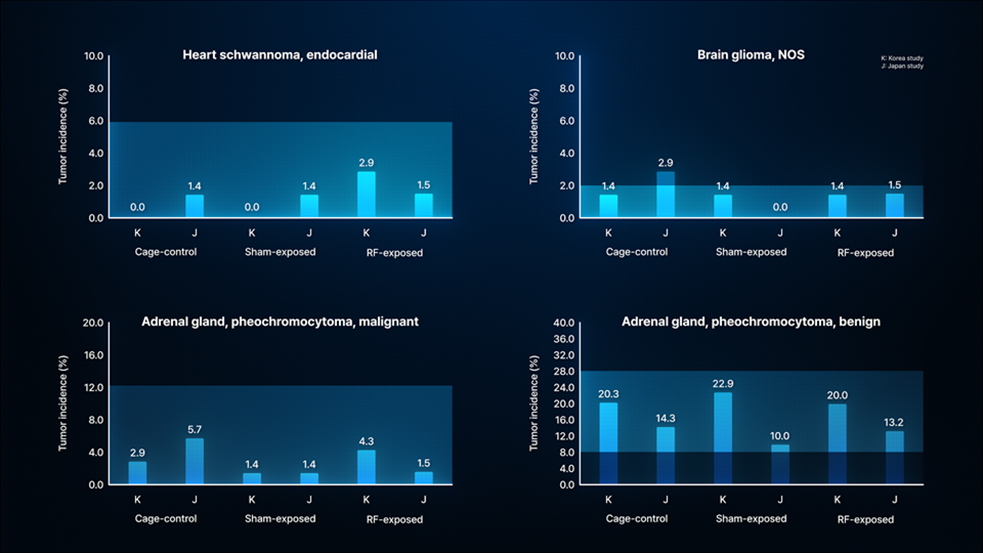 Tumor incidence in the heart, brain, and adrenal glands
In conclusion, the study found no evidence of a causal relationship between long-term exposure to CDMA-modulated mobile phone RF electromagnetic fields and the development of tumors in experimental animals.
Professor Young Hwan Ahn of Ajou University School of Medicine, the principal investigator of the study, stated that the results are meaningful in that the tumor increases reported by the NTP were not reproduced at exposure levels relevant to human safety guidelines. He added that the findings may help alleviate excessive public concern regarding mobile phone electromagnetic fields and are expected to serve as an important reference for future evaluations by the International Agency for Research on Cancer (IARC).
Yong-Bum Kim, Principal Researcher at the Korea Institute of Toxicology (KIT), who oversaw the long-term exposure study and pathological analysis, noted that the pathological evaluation ensured objectivity through cross-validation by experts from both countries as well as independent international third-party peer review, and that no clear association between RF exposure and carcinogenicity was identified.
Jung-Ick Moon, Director of the Radio Environment & Monitoring Research Section at ETRI, emphasized that the study is significant not only for its scientific findings but also for establishing a standardized protocol for international collaborative animal studies and a framework for integrating and analyzing experimental data across countries. He added that future research will focus on large-scale studies to investigate potential health effects in complex radio environments where 4G and 5G coexist.
This study was conducted as part of national R&D programs supported by the Ministry of Science and ICT and the Institute of Information & Communications Technology Planning & Evaluation (IITP), including projects on ‘A study on public health and safety in a complex EMF environment’ and ‘A systematic study on health risk of EMF exposure in advanced wireless service environments’.
The results were published simultaneously in Toxicological Sciences, with separate papers contributed by the Korean and Japanese research teams.
For this study, the Korean team consisted of Dr. Hyung-Do Choi’s team from ETRI, the project manager, Professor Young Hwan Ahn’s team from Ajou University School of Medicine, and the Korea Institute of Toxicology (KIT), which is equipped with a Good Laboratory Practice (GLP) environment.
In Japan, the study was carried out by a collaborative team comprising Professor Imaida’s group at Kagawa University, DIMS, a toxicology research organization, and the Nagoya Institute of Technology.
ETRI has achieved continuous excellence results in the field of bioelectromagnetics research, including being selected as one of the Top 100 National R&D Achievements in 2015, 2018 (Best), and 2023, and will continue to contribute to establishing scientific evidence for the protection of public health.
Hyung-Do Choi, Research Special Fellow
Radio Environment & Monitoring Research Section
(+82-42-860-5814, choihd@etri.re.kr)