

ICT TREND
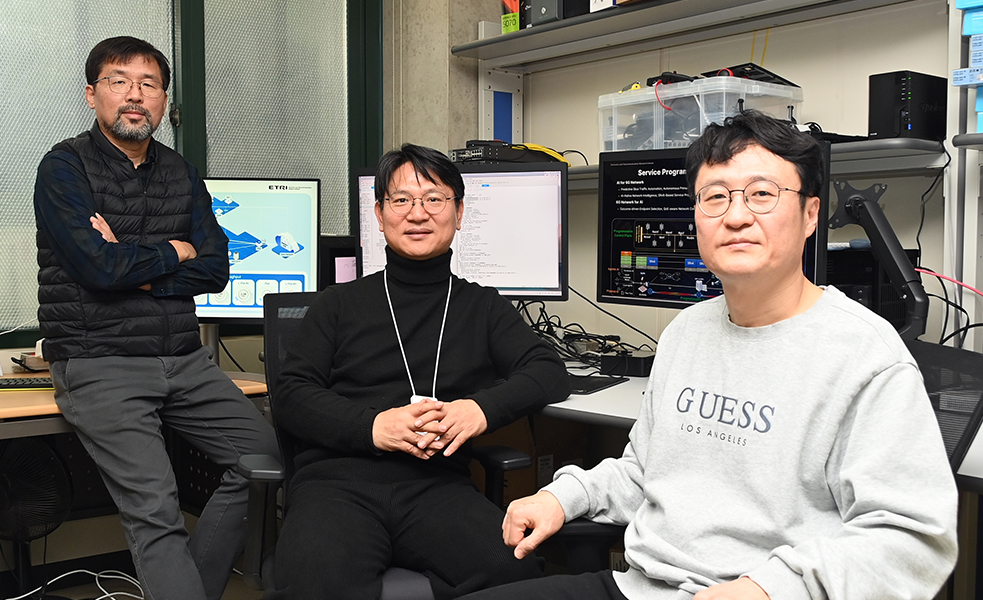
A Korean research team has developed the “intelligent core” of a 6G network capable of autonomous control through artificial intelligence (AI). This achievement marks the first realization of an “intelligent 6G core” in Korea and represents a significant milestone in advancing next-generation network infrastructure.
Electronics and Telecommunications Research Institute (ETRI) announced that it has successfully developed an “intelligent, service-programmable mobile core network,”1)Service Programmable Mobile Core Network: A next-generation mobile core architecture that enables flexible reconfiguration of control and user planes based on service requirements. It supports dynamic QoS assurance through service-aware routing and control. a key enabling technology for the 6G era. This technology aims to realize an autonomous 6G core in which AI continuously learns and controls network operations, enabling dynamic adaptation to diverse service requirements.
Unlike conventional 5G core networks, which rely on relatively static session management structures, the proposed technology leverages AI-driven prediction and control to optimize service-specific sessions, routing paths, and quality of service (QoS)2)Quality of service (QoS): A set of mechanisms and policies to ensure the performance of data transmission. in real time. In particular, by incorporating SRv6 (Segment Routing over IPv6)3)SRv6 (Segment Routing over IPv6): A technology that defines network paths as a sequence of segments in IP-based networks, enabling flexible and programmable traffic steering, replacing conventional GTP-based fixed paths., the network can dynamically configure data transmission paths based on service characteristics. This enables automatic establishment and adjustment of sessions and routes, ensuring service-aware and performance-optimized connectivity.
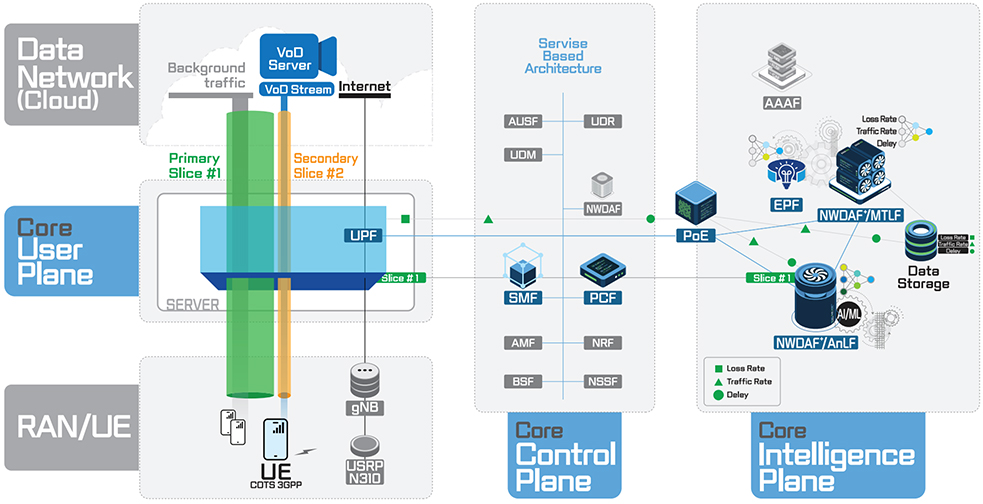 AI-Based Network Automation
To this end, the research team developed ▲an AI-native control and user plane architecture (Extension of SBA4)SBA (Service-Based Architecture): A service-based architecture (SBA) for mobile core networks, first introduced in 5G.) ▲an intelligent automation and reliability verification module ▲training and inference optimization technologies for AI applications. These advancements collectively enable an autonomous 6G core foundation where the network can self-learn, make decisions, and operate with minimal human intervention.
Performance evaluation results show a 40% improvement in session processing efficiency compared to conventional GTP5)GTP (GPRS Tunneling Protocol): A tunneling protocol used to deliver user data in mobile communication networks.-based architectures with fixed routing paths. The system also supports fine-grained control of QoS parameters such as latency and bandwidth, along with service-specific path differentiation. By integrating reinforcement learning-based policy recommendation mechanisms, the solution achieves End-to-End AI automation (Level 3)6)End-to-End AI Automation (Level 3): An autonomous operation stage in which AI independently judges and controls the entire network end to end., enabling fully automated session and traffic control without operator involvement. This indicates that AI can autonomously determine and enforce policies across the entire network.
The technology is expected to significantly enhance operational efficiency for telecom operators by minimizing manual intervention through AI-driven automation, while also reducing operational costs and optimizing resource utilization.
The proposed architecture has been submitted to the 3GPP7)3GPP (3rd Generation Partnership Project): An international standardization body governing mobile communications which defines the technical specifications and standards for next-generation mobile communication systems such as 5G and 6G. Contributions span multiple working groups, including SA2 (System Architecture), RAN (Radio Access Network), and SA6 (Service Framework). SA28)SA2: A key working group in 3GPP that designs 5G and 6G core network architectures. standardization group, where it is currently under discussion. In addition, more than 60 core patents have been filed, and related research findings have been published in IEEE Communications, demonstrating achievements across technical innovation, standardization, and academia.
Taesik Cheung, Assistant Vice President, Network Research Division stated, “This work represents a major milestone, demonstrating that 6G core networks are evolving beyond simple data processing systems into intelligent platforms where AI autonomously makes decisions and controls operations. We will continue to advance next-generation 6G core technologies based on the evolved SBA9)Evolved SBA (Evolved Service-Based Architecture): An enhanced SBA framework for 6G that extends service-based principles to both control and user planes, enabling cloud-native and programmable network operations. framework.”
Namseok Ko, director of the Mobile Core Network Research Section, added, “By integrating AI-driven control with network automation, we have established a practical foundation for realizing AI-native 6G.”10)AI-Native 6G: A paradigm in which AI is not an add-on but a fundamental design principle of the network.
This research was conducted as part of the “6G Core Technology Development Program” supported by the Ministry of Science and ICT and the Institute of Information & Communications Technology Planning & Evaluation (IITP), in collaboration with SK Telecom, LG Uplus, and SNETICT.
Looking ahead, ETRI plans to further develop ▲Core-transport network convergence technologies based on evolved SBA, ▲Architectures supporting low Earth orbit (LEO) satellite communications. Through these efforts, ETRI aims to realize a next-generation 6G core architecture that seamlessly integrates services, computing, and networking, while strengthening its leadership in global 6G standardization and collaboration.
Namseok Ko, Director
Mobile Core Network Research Section
(+82-42-860-5560, nsko@etri.re.kr)