

Vol.87
March
KOR
NEWS

ETRI’s Top News

NEWS 1
ETRI Achieves 100-meter Underground Wireless CommunicationApplied to Underground Disaster Response

- Develops world’s first 100-meter underground magnetic field communication technology
- Effective in underground facilities safety management...Leading the way in overcoming underground and underwater communication challenges
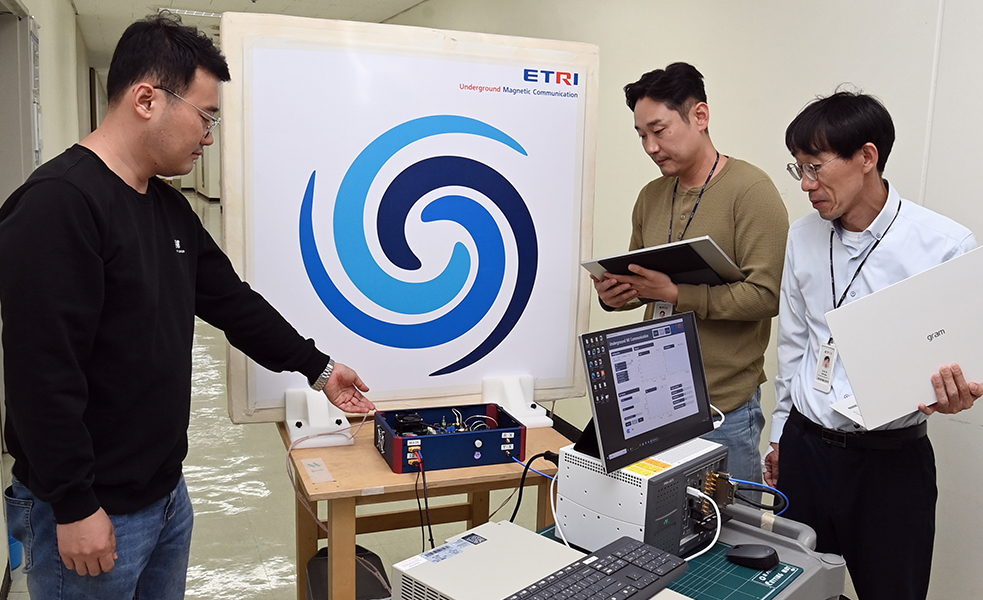
ETRI researchers preparing for long-distance magnetic field communication tests by using a transmitting antenna and a receiving device for underground communication experiment

Korean researchers confirmed that underground wireless communication is possible, moving beyond the terrestrial wireless communication they have primarily focused on until now. This opened up a new wireless channel for confirming the survival of buried people in the event of a collapse of an underground facility such as a mine, conducting underground rescue operations, or conducting underground military operations.

ETRI announced that it has succeeded in developing the world’s first “magnetic field underground communication source technology” that can transmit and receive voice signals 100 meters underground in a mine using a 1-meter diameter transmitting antenna and a several-centimeter-class receiving antenna.
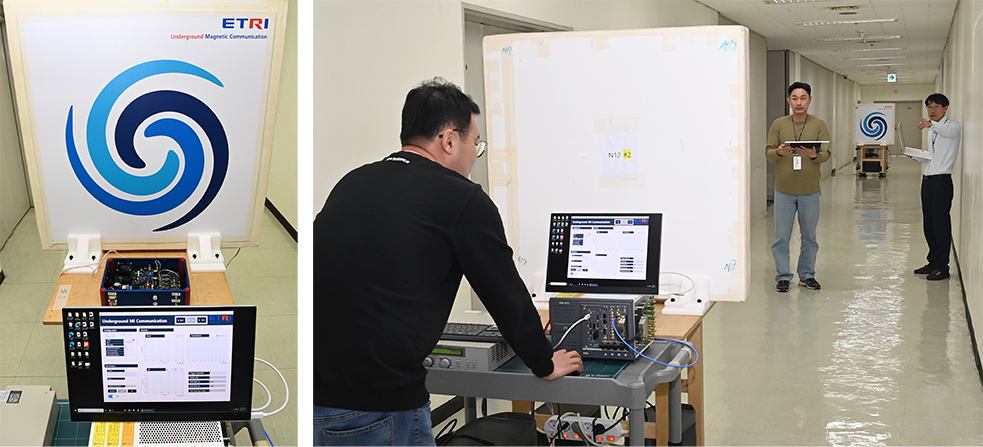
(Left) The low-frequency magnetic field–based underground communication transmission and reception system and test equipment developed by ETRI
(Right) ETRI researchers conducting an underground magnetic field communication experiment with the transmission and reception distance secured

This technology confirms the feasibility of voice transmission and reception in underground spaces previously inaccessible by wireless technology. Accordingly, this technology is expected to be applied in activities such as rescue operations, military operations, and common utility tunnel safety management.

In particular, this research is based on test results conducted in a limestone bedrock environment where underground communication is known to be virtually impossible, and is considered to have opened up a new area of ​​underground space communication technology, such as rescue operations and military operations.

Underground mines have very severe signal attenuation, making them inaccessible using existing wireless communication technologies.

ETRI focused on the stable transmission of magnetic fields in underground media and developed a low-frequency magnetic field-based communication system.

The researchers implemented communication using a 1-meter-diameter transmitting antenna, a small magnetic field receiving sensor of several centimeters in size, a frequency of approximately 15kHz1)15kHz: It is a very low-frequency band with a very small bandwidth, not the MHz or GHz range commonly used in general wireless communication. It is a frequency band designed to reduce medium losses and transmit data in underground or underwater environments, taking into account factors such as antenna size., and a data rate of 2-4kbps2)4kbps: It is a data size sufficient to send voice data (applied only to uplink) and is comparable to the level of data transmitted and received by pressing a radio button., which is sufficient for voice communication.

They successfully conducted bidirectional communication testing within a 100-meter straight-line distance between the mine entrance (ground level) and the fifth underground layer. This is the world’s first demonstration that surpasses existing tens-of-meters level overseas research.

This outcome signifies the possibility of communication between buried persons and rescue teams in situations such as underground disasters, including mine collapses. Also, it can be widely utilized in various fields, such as responding to disasters at common utility tunnels, gas pipelines, and oil pipelines, ensuring communication continuity during military operations in underground bunker environments, and more.

ETRI explained that it is advancing technologies linked to personal devices such as smartphones, and that this will make wireless relays (APs) connecting ground and underground possible.

This technology has been described in the IEEE IoT Journal3)IEEE IoT Journal: “Wideband Magnetic Induction Wireless Communications in Challenging Underground Environments: A Current-Driven Scheme.” (Volume: 12, Issue: 13, pp.24929~24942), an international academic journal in the field of communications, and domestic and international patent applications have been completed for key elements such as the transmitter/receiver, antenna, low-frequency modem, and bandwidth expansion technology. 12 SCI papers in publication, 2 presentations at international academic conferences, 8 international patents, and technology transfer were accomplished.

Cho In Kui, Principal Researcher of ETRI’s EM Wave Basic Technology Research Section, stated, “This is a technology that can significantly reduce the possibility of communication disruption during rescue operations in the event of a mine accident, as much as it has succeeded in communication in underground environments where radio waves do not reach.”

Seung Keun Park, Assistant Vice President of ETRI’s Radio Research Division, also said, “This is an innovative technology necessary not only for mines but also for extreme environments such as tunnels, underground facilities, offshore drilling, and national defense. It will be utilized in various industrial sectors as a highly reliable communication means.”

This research outcome is the result of the project “[Specialized Research Section] 10pT-Class Microscale Magnetic Field-Based Mid-Range Magnetic Communication Technology” under the ETRI R&D support program supported by the Ministry of Science and ICT and the Institute for Information & Communications Technology Planning & Evaluation (IITP). Development tests were conducted in collaboration with Admotech Co., Ltd. and Doit Co., Ltd.

Cho In Kui, Principal Researcher
EM Wave Basic Technology Research Section
(+82-42-860-1242, cho303@etri.re.kr)
NEWS 2
ETRI Holds Roundtable with Domestic Broadcast Media Companies on Global Expansion

- Discussion on global market entry after adoption of Brazil’s broadcasting standard (DTV+)
- Domestic broadcasting technology leads global standards...will lay the foundation for the ecosystem together with companies and the government

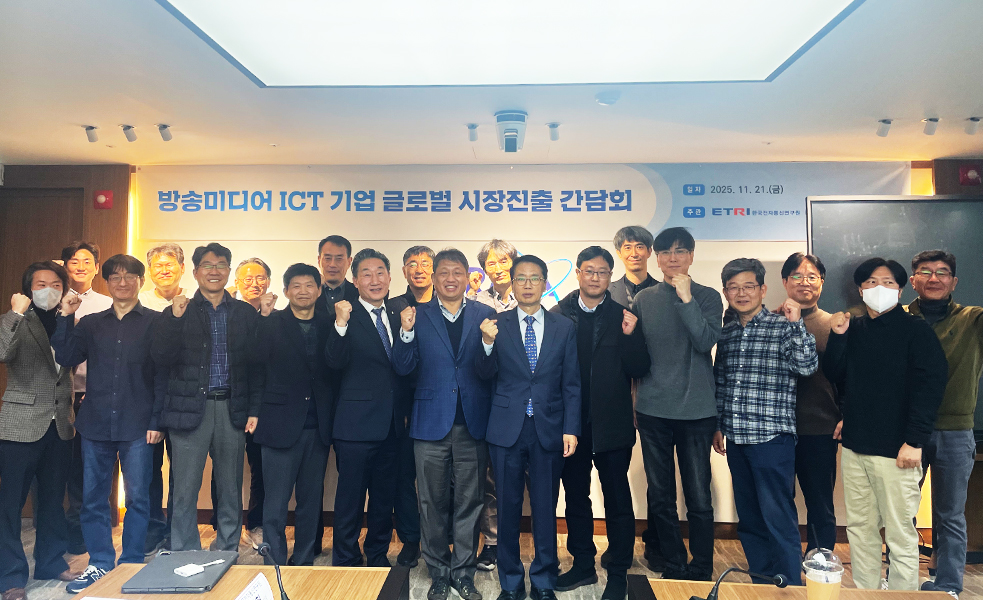
Electronics and Telecommunications Research Institute (ETRI) announced that on November 21, 2025, it held a “Roundtable on Global Market Entry for Domestic Broadcast Media ICT Companies” at the Korea Radio Promotion Association (RAPA) headquarters in Seoul, where participants discussed cooperation strategies to strengthen the export competitiveness of domestic broadcasting equipment companies and expand into the Latin American market.

This meeting was organized at a time when the Korean broadcasting media industry is facing a new opportunity for a leap forward in the global market after the broadcasting transmission technology developed by ETRI was officially adopted as Brazil’s next-generation broadcasting standard (DTV+)1)Next-Generation Broadcasting Standard (DTV+): Supports next-generation broadcasting environments such as Ultra High Definition (UHD) video, interactive services, and mobile reception by introducing ATSC 3.0-based technology. in August 2025.

The main purpose of this meeting is to flesh out strategies for creating an export ecosystem in Latin America through cooperation between the government, research institutes, and companies.

The event was attended by Jeong-Ik Lee, Senior Vice President of the Hyper-Reality Metaverse Research Laboratory of ETRI, as well as officials from major organizations and companies in the broadcasting and media fields, including the Ministry of Science and ICT, RAPA, the Korea Institute of Broadcast and Media Engineers, Samsung Electronics, LG Electronics, and Hyundai Mobis.

In the meeting, practical support measures were intensively discussed, such as ▲market outlook after the adoption of Brazil’s DTV+ ▲the need to develop domestically produced receiver chips2)Receiver Chip: A core semiconductor component that receives broadcasting signals and converts them into digital video and audio, responsible for the broadcasting reception function of various terminals such as TVs, set-top boxes, and vehicle receivers. ▲joint overseas expansion strategies for TV and transmission equipment companies ▲and NAB 2026 (international broadcast equipment show) and local cooperation plan in Brazil.

In August 2025, the Brazilian government finalized the next-generation broadcasting standard “DTV+” as the national standard through a presidential decree. This standard reflects a transmission technology that combines ATSC 3.03)ATSC 3.0: A next-generation terrestrial broadcasting standard jointly led and developed by the United States and South Korea, supporting Ultra High Definition (UHD) video, high-quality sound, personalized services, and mobile broadcasting through IP-based transmission.-based Multiple Input Multiple Output (MIMO)4)Multiple Input Multiple Output (MIMO): A wireless communication technology that enhances transmission speed and signal quality by employing multiple antennas at both the transmitter and receiver to simultaneously send and receive data. antennas and Layered Division Multiplexing (LDM)5)Layered Division Multiplexing (LDM): A technology that transmits different signals in a hierarchical layered structure within a single frequency band, simultaneously supporting both fixed and mobile reception to maximize frequency efficiency. developed by ETRI.

Brazil is the largest broadcasting market in South America and a strategic partner of significant influence, having expanded its first-generation digital broadcasting standard (ISDB-TB)6)1st Generation Digital Broadcasting Standard (ISDB-TB, Integrated Services Digital Broadcasting Terrestrial, Brazil): The 1st generation digital broadcasting standard introduced by Brazil by modifying and supplementing Japan’s terrestrial digital broadcasting system (ISDB-T) to suit its own conditions. The Brazilian government has spread this standard to South American countries, and currently 14 countries, including Argentina, have adopted and are operating this broadcasting system. to 14 neighboring countries including Argentina, making it a key hub for strengthening regional broadcasting technology cooperation and inter-governmental coordination.

At the meeting, ETRI emphasized the potential market value of the ATSC 3.0 standard and the importance of a preemptive commercialization strategy through rapid technology development. According to data from global media research institutions such as Nielsen, the potential market size of ATSC 3.0 is estimated to be approximately 1.7 trillion KRW7)Potential Market Size of 1.7 Trillion KRW: Source: Nielsen (2024), etc., total of equipment and receiver terminals. by 2031.

Also, the sales of equipment and receiving terminals expected to be secured by domestic companies from 2026 to 2031 are projected to be approximately 1.4 trillion KRW8)Domestic Company Sales of 1.4 Trillion KRW: Source: dell'oro ('25), etc., total of equipment and receiver terminals.. In particular, it was emphasized that a strategic market approach for this field is necessary, as TV tuners9)TV Tuner: Source: dell'oro ('25), etc., accounting for 1.0489 trillion KRW (75.8%) out of total sales of 1.3836 trillion KRW. account for about 1 trillion KRW, or 75.8% of the total.

However, as there are currently no domestic receiver chips to support the Brazilian DTV+ standard, it was highlighted that government-led domestic receiver chip development and R&D support measures are urgently needed in order to enter new markets and secure price competitiveness.

It was emphasized that ATSC 3.0 is a technology jointly developed by domestic companies including ETRI, Samsung Electronics, and LG Electronics, and was first introduced by South Korea, making it a field in which rapid results can be achieved through close cooperation and is advantageous for market settlement.

At this meeting, ETRI and domestic companies agreed on the need for rapid technology development and early commercialization based on mutual cooperation, and decided to seek export strategies and to build organic cooperation framework for domestic broadcasting equipment and terminal manufacturers to enter and preoccupy overseas markets.

Jeong-Ik Lee, Senior Vice President of the Hyper-Reality Metaverse Research Laboratory at ETRI, said, “The adoption of the DTV+ standard in Brazil is a historical achievement by which South Korea presented the criteria for global broadcasting technology, beyond simple technology export,” and added, “ETRI will actively promote the development of domestic DTV+ receiver chips, global trial broadcasting, and local joint demonstrations in Brazil and South America in cooperation with the government and companies to firmly establish a foundation for domestic companies to enter overseas markets.”

ETRI plans to continue strengthening technology development, international cooperation, and local demonstrations in Brazil to expand the global competitiveness of the broadcasting media industry.

The research related to this technology was conducted under the projects “Development of Transmission Technology for Ultra High Quality UHD”, “Development of Transceiver Technology for Terrestrial 8K Media Broadcast”, and “Development of Receiver Chip for ATSC 3.0 Mobile Broadcast” supported by the Ministry of Science and ICT and the Institute of Information & Communications Technology Planning & Evaluation (IITP).

Jae Hyun Seo, Director
Media Broadcasting Research Section
(+82-42-860-4869, jhseo@etri.re.kr)

NEWS 3
ETRI Expands Computing Resources with Light...Opening a New Era for AI Datacenters

- Connecting CPUs, memory, and GPUs with light to open a new way for next-generation datacenters
- Preempting next-generation optical network technology...Implementing the world’s first verification system

A team of Korean researchers has developed the world’s first technology that can freely connect and disconnect core computing resources such as memory and accelerators with “light” in next-generation artificial intelligence (AI) datacenters.

Electronics and Telecommunications Research Institute (ETRI) announced the development of a new optical switch based datacenter resource interconnection technology (Optical Disaggregation, OD).

This technology is regarded as a core next-generation optical network technology that is designed to resolve the shortage of computing resources due to the increasing AI services and that enables faster and more efficient operation of future datacenters.

Current datacenters are designed based on a server-centric architecture in which CPUs, memory, storage, and accelerators (GPUs) are bundled within a single server.

In this architecture, only the limited resources installed in the same server can be utilized, leading to problems in which overall efficiency drops due to large deviations in resource utilization, such as some servers using only memory excessively while others use only the CPU.

In addition, most datacenters use electrical packet-based switches, which causes delays as multiple optical-electrical-optical conversions occur during the data switching process. These delays limit the performance of delay-sensitive operation such as connecting remote memory resource and large-scale AI training.

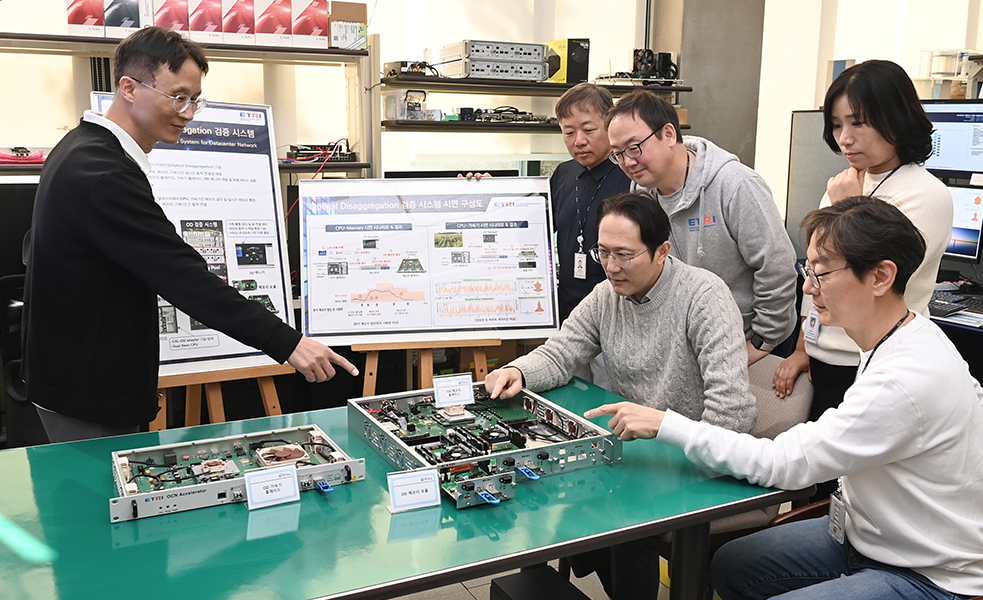
The Optical Disaggregation (OD) technology developed by ETRI fundamentally solved these structural limitations. When memory or accelerators within a server are insufficient, an optical switch can be used to instantly connect remote resources to the server via an optical switch.

This enables resources to be connected and disconnected rapidly and flexibly, exactly when needed and in the exact amount required, even for tasks demanding high-performance computing such as AI training or large-scale data analysis.

In particular, this technology is significant in terms of global technological competitiveness as it is the world’s first case of connecting the Compute Express Link (CXL) standard with an optical switch.

The research team successfully demonstrated the technology by building a verification system combining ETRI’s in-house developed CPU adapter, memory blade, accelerator blade, and OD manager.

The experiment confirmed that when a service program requests additional resources, the optical path is automatically set to allocate the necessary memory and accelerators in real-time, and the service is steadily provided. In other words, they demonstrated for the first time in the world a system that can provide light speed connection between datacenter resources using software control.

ETRI secured original patents related to CXL applied to this technology and filed 47 domestic and international patents for related technologies. In addition, the research results were presented at the Optical Fiber Communications Conference and Exposition (OFC) and the European Conference on Optical Communication (ECOC), the most prestigious conferences in the field of optical communication, gaining recognition for its technological prowess in the international academic community.

Furthermore, this research officially proved its excellence by being included in the “Top 100 Excellent National R&D Performances” selected by the Ministry of Science and ICT in 2023.

Lee Jun Ki, Director of Optical Network Research Section at ETRI, said, “Datacenter resources are being consumed rapidly worldwide due to the increase of AI services. This research achievement will serve as an important opportunity to resolve the datacenter resource shortage problem by efficiently sharing and utilizing memory and accelerators, and to accelerate the transition to sustainable future datacenters.”

This research was conducted as part of the “Development of Core Technologies for Optical Cloud Networking” project supported by the Ministry of Science and ICT. ETRI plans to apply this technology across a range of fields, including the advancement of national AI infrastructure, integration of cloud and supercomputing, and the development of eco-friendly datacenters for driving innovation across industries.

Lee Joon Ki, Director
Optical Network Research Section
(+82-42-860-1659, juneki@etri.re.kr)