

FOCUS ON ICT
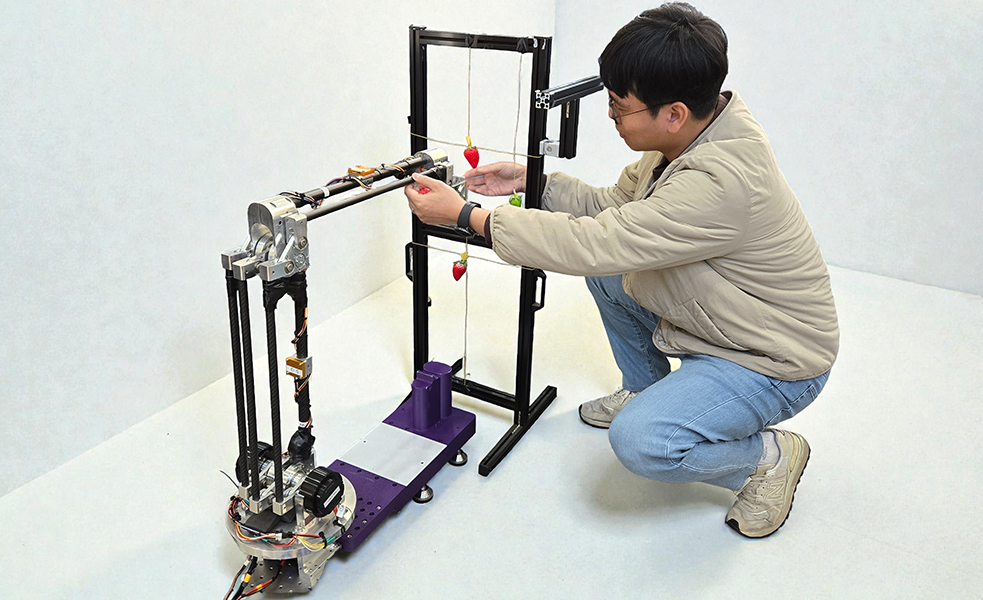
A team of Korean researchers will jointly develop next-generation smart agriculture1)Smart Agriculture: A next-generation form of agriculture that automatically controls the growth environment of crops using artificial intelligence (AI), robots, the Internet of Things (IoT), and big data to improve productivity and quality while reducing labor and costs. technology that converges Artificial General Intelligence (AGI)2)Artificial General Intelligence (AGI): Unlike Narrow AI, which is limited to specific tasks, it is an advanced artificial intelligence technology that can learn, understand, and apply problems in various fields on its own, like a human. In this agreement, it will be used to develop decision-making and prediction models for smart agriculture as a whole., multi-agent systems, and AI robot technologies, and will begin full-scale cooperation to establish an industrialization foundation by demonstrating it in actual agricultural fields.
Electronics and Telecommunications Research Institute (ETRI) announced that it has decided to join forces with Damyang-gun (a rural village of South Korea), the Smart Farm Convergence Research Center at the KIST Gangneung Branch, and the Human-Robot Interaction Core Research Center at KAIST for “AI-Robot Convergence Smart Agriculture Technology Development and Demonstration Cooperation.”
Through this cooperation, the four organizations will jointly develop new core technologies across the entire smart agriculture life cycle, including ▲AI/data-based precision cultivation technology ▲crop growth environment optimization technology ▲autonomous agricultural robot operation technology ▲productivity prediction model development, and create a sustainable smart agriculture ecosystem.
In addition, they are building strategies to secure both the field applicability and expansion potential of the developed technology by establishing a field demonstration platform in which local farmers directly participate.
In particular, at the center of this cooperation is the development of a next-generation intelligent agricultural operation model using AGI and multi-agent technology3)Multi-Agent Technology: A technology that allows multiple independent intelligent agents to solve complex problems in a distributed manner through mutual cooperation, competition, and coordination.. The plan is to realize the goal of significantly improving agricultural productivity and operational efficiency by building an intelligent agricultural operation model that analyzes, judges, and operates in an integrated manner, moving away from the existing method of individually managing various agricultural elements such as crops, the environment, and robots.
The roles of each organization in this project are divided as follows: ETRI will oversee the development of core smart agriculture technologies based on AGI and multi-agents, and lead the technical demonstration of an integrated operation of greenhouses, sensors, robots, and data. It will also establish an industry-university-research-government cooperation framework and be responsible for planning cooperative projects with the government and local governments.
Damyang-gun will support productivity improvement by providing smart agriculture demonstration complexes, expanding agricultural infrastructure, and providing technology dissemination and education for local farmers.
In addition to providing a smart agriculture demonstration complex, Damyang-gun plans to support the expansion of agricultural infrastructure and productivity enhancement through on-site demonstration of developed technologies and technology dissemination and training for local farmers.
The KIST Smart Farm Convergence Research Center will be in charge of developing data-based growth management and environment optimization technologies and demonstrating unmanned agricultural systems and operation models. The KAIST Human-Robot Interaction Core Research Center plans to conduct research on AGI-based agricultural data analysis and prediction models and develop smart agriculture service models based on robot interaction technology.
Each institution plans to build an automated and intelligent smart agriculture operating system based on AI, robots, and sensors to solve structural problems facing Korean agriculture, such as climate change, a decrease in the agricultural population, and a decline in productivity.
The goal is to gradually spread practical agricultural innovation technologies such as precision cultivation models, yield prediction algorithms, intelligent agricultural robot systems, and integrated control platforms.
Byun Woo jin, Vice President of the Daegu-Gyeongbuk Research Division at ETRI, said, “Smart agriculture, which combines AI and robots, is a key growth area for future agriculture that can increase productivity and efficiency at the same time. Through this agreement, we will not only develop technology but also increase the effects felt by farmers, focusing on actual field demonstrations, and create a sustainable agricultural innovation ecosystem,” he said.
Going forward, the team plans to promote smart agriculture demonstration projects in earnest, such as ▲advancing AGI-based agricultural data analysis and prediction models ▲demonstrating robot, AI, and sensor fusion in greenhouse and smart farm4)Smart Farm: An agricultural technology field that maximizes productivity and quality while minimizing input resources by scientifically managing and analyzing agricultural work based on various data such as soil, weather, and crop growth. environments ▲developing customized precision cultivation technologies centered on regional specialized crops ▲jointly identifying and promoting smart agriculture projects linked to the government and local governments ▲and establishing a foundation for the commercialization of intelligent agricultural operation platforms.
Meanwhile, ETRI signed a “Memorandum of Understanding (MOU) for AI/Robot Convergence Smart Agriculture Technology Development and Demonstration Cooperation” with Damyang-gun, the KIST Gangneung Branch Smart Farm Convergence Research Center, and the KAIST Human-Robot Interaction Core Research Center at the ETRI Daegu-Gyeongbuk Research Division in October 2025.
ETRI is promoting the “Daegu-Gyeongbuk Region Industry-based ICT Convergence Technology Advancement Support Project (Mobility)” with support from the Ministry of Science and ICT.
Lee Laekyoung, Director
Mobility AI Convergence Research Section
(+82-53-670-8045, laeklee@etri.re.kr)