ETRI Webzine


News
Vol.86 December
- AI autonomously reconstructs and interprets wireless data signals, improving transmission efficiency tenfold
-AI-based 6G core technologies secured, laying the foundation for leadership in the AI-native era
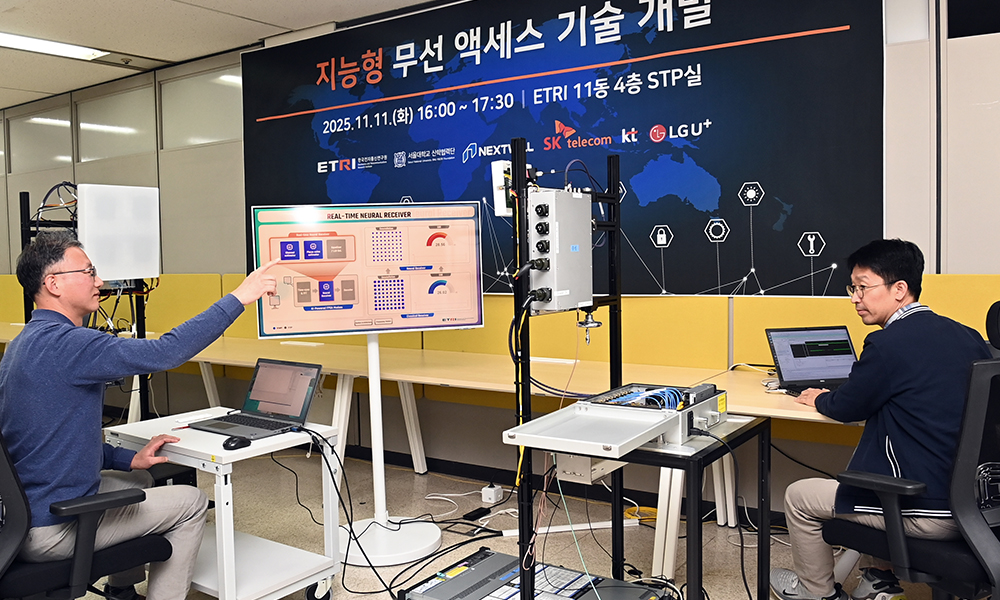
Korea’s research community has reached an important milestone on the path toward next-generation mobile communications with the development of a technology platform that brings the 6G era closer. Researchers expect that AI-Native1) mobile networks, in which artificial intelligence autonomously controls and optimizes the communication system, could achieve transmission efficiencies up to 10 times higher than those of 5G.
ETRI announced that it has completed the development of AI-based wireless access technology (AI-RAN)2), a core foundational technology for the 6G era, and has achieved significant results in paving the way for the AI-based next-generation mobile communication era.
The biggest feature of this technology is that it has applied AI to wireless transmission, network control, and edge computing3) throughout the network to reliably handle large volumes of data even in ultra-dense network environments. Through this, it aims to achieve up to 10 times higher transmission efficiency compared to 5G and the technology is being evaluated as a core foundational technology for the realization of AI-native 6G networks.
ETRI researchers have successfully implemented an AI-RAN structure by which AI learns the state of wireless networks and independently adjusts to the optimal connection environment.
AI-RAN technology performs ▲channel state analysis for beamforming and power control, ▲cooperation and interference management between base stations, ▲edge traffic prediction and distribution, ▲delay minimization, and more, ensuring stable communication quality even in ultra-high-density environments. Through this, it has become possible to provide ultra-high-speed services seamlessly in diverse user environments.
In particular, one of the representative achievements of this research, the Neural Receiver technology, is a next-generation reception technology by which AI directly restores wireless signals and immediately detects errors. While the existing wireless reception method faced limitations in achieving stable performance in high-frequency environments due to its reliance on a statistical model-based step-by-step processing method, neural receivers4) can reliably maintain performance by allowing AI to learn complex channel environments on its own.
Experimental results showed that AI-based receivers in millimeter-wave environments demonstrated superior performance compared to existing methods, including ▲approximately 18% improvement in data recovery accuracy, ▲approximately 15% improvement in channel prediction accuracy, and ▲a 30% reduction in data loss rate. This demonstrates that AI technology can dramatically improve communication efficiency even in wireless transmission environments.
ETRI is strengthening its global 6G technology competitiveness by leading the standardization of technologies such as “AI/ML-based wireless interface” and “AI-based mobility management” in 3GPP5), an international standardization organization.
To date, ETRI has achieved outstanding results in the fields of research, technology, and standardization, including ▲applying for 119 domestic and international patents ▲contributing 68 technology articles to 3GPP, 12 of which were adopted ▲publishing 17 SCI papers. ETRI is also pursuing the acquisition of standard patents in core AI-RAN technologies.
ETRI plans to develop this achievement into a “Self-Evolving RAN6)” technology, by which AI independently learns and evolves to maintain optimal communication performance. It will also continue to strengthen its capabilities to ensure Korea leads the way in AI network technology in the 6G era through AI-RAN Alliance7) activities, international joint research, and participation in global exhibitions such as MWC.
Yongsoon Baek, Senior Vice President of ETRI’s Terrestrial & Non-Terrestrial Integrated Telecommunications Research Laboratory, stated, “AI-based wireless access technology is the first step in directly implementing the core functions of communication networks through AI, and it will serve as an important milestone in realizing 6G ‘AI-Native Networks.’”
Jungsook Bae, Director of ETRI’s Intelligent Wireless Access Research Section, also stated, “We have confirmed that AI can intervene in the actual wireless transmission process to overcome the limitations of existing mobile communication. We will develop and move forward with autonomous wireless technology that predicts and controls the entire network in the future.”
This research was conducted as part of the “6G Core Technology Development Project” supported by the Ministry of Science and ICT and the Institute of Information & Communications Technology Planning & Evaluation (IITP), and was carried out in collaboration with Seoul National University, Nextwill Co., Ltd., SKT, KT, LG Uplus, Korea University, Pohang University of Science and Technology (POSTECH), Sungkyunkwan University, Inha University, and Chungnam National University.
1) AI-Native: A form in which AI is not an auxiliary function but becomes the center of the system, with the entire structure and operation designed accordingly.
2) AI-RAN: Artificial Intelligence-based Radio Access Network. As a wireless access method that utilizes AI technology to optimize wireless network resource utilization and transmission performance in real time, it refers to a core 6G technology that integrates and optimizes transmission, control, and edge resources of wireless networks using AI.
3) Edge Computing: A computing method that reduces latency and increases real-time performance by processing data locally at the edge of the network, such as terminals or base stations, instead of sending the data to a central cloud.
4) Neural Receiver: AI-based receiver that performs channel estimation, correction, and restoration of wireless data signals.
5) 3GPP: International Mobile Telecommunications Standardization Organization. (3rd Generation Partnership Project)
6) Self-Evolving RAN: A completely autonomous wireless network by which the network learns and evolves on its own.
7) AI-RAN Alliance: A global industry-academia-research council formed in 2024 to fully integrate AI technology into radio access networks (RAN) to innovatively improve RAN operational performance and simultaneously provide AI-based services on the same infrastructure to create new revenue opportunities.
Jungsook Bae, Director
Intelligent Wireless Access Research Section
(+82-42-860-4933, jsbae@etri.re.kr)
- Easy software development with one-time execution even for those with limited AI software knowledge
- Evolving from vision MLOps tool to generative AI LLMOps tool
- No-code neural network development framework unveiled at Tango Conference Seminar on November 6th
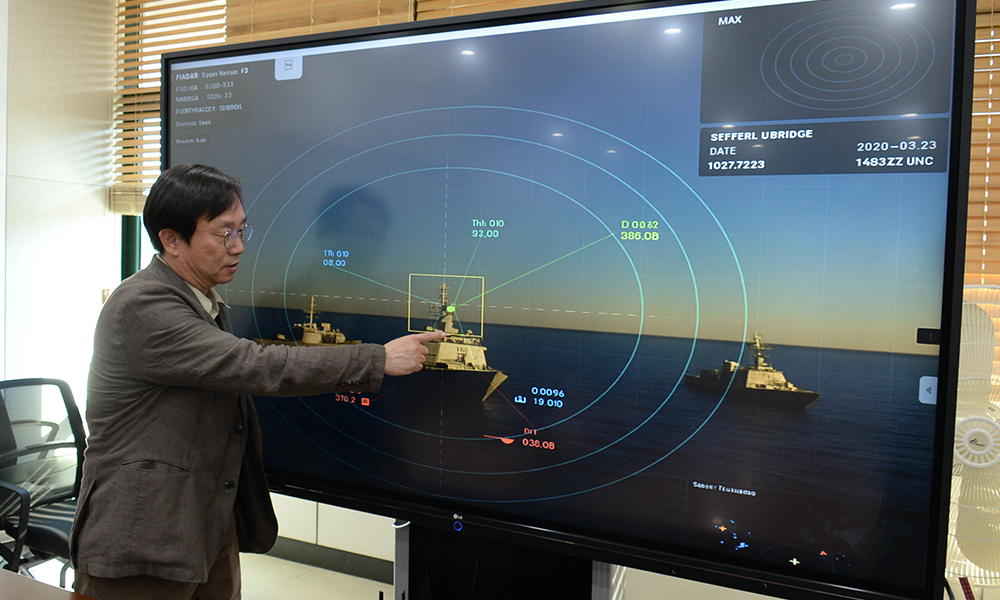
Since 2021, Korean researchers have been providing a simple software development framework to users with relatively limited AI expertise in industrial fields such as factories, medical, and shipbuilding, providing them with a significant boost.
ETRI announced that it has released the core technology of MLOps1) tool, which automatically generates neural networks based on no-code2) and automates the deployment process, as open source on GitHub3).
On November 6th, the research team held the 4th public seminar to expand the TANGO4) GitHub community at the Science and Technology Center in Gangnam-gu, Seoul.
The TANGO framework is a technology that automatically develops application software (SW) in which artificial intelligence is applied and optimally deploys it to various target hardware (HW) environments, such as cloud, Kubernetes on-premise environments5), and on-device.
For example, while it’s easy to determine whether steel data is defective during quality inspections at a steel mill, applying AI was not easy. In a hospital, it is easy for doctors to diagnose tuberculosis just by looking at an X-ray image, but it has been difficult to utilize an AI-based automatic prediction model.
The TANGO framework developed by ETRI is well suited to neural network processing tasks for domain experts who lack extensive neural network knowledge. It is also easy to use, so it is automatically installed with a simple installation command and can be run immediately through web interface.
In the existing method of developing AI application software, domain experts were responsible for data labeling6), while software developers handled the development and learning of artificial intelligence models and the installation and execution of application SW.
However, with the expansion of artificial intelligence (AI) technology, the demand for software (SW) in all industries is increasing. On the other hand, there is a shortage of AI and SW specialists to meet this demand.
To address such issues, ETRI has developed the neural network automation algorithm optimized for object recognition, reflecting the demands of domestic industrial sites, and has officially unveiled it. ETRI also released LLMOps7) tools that support the development of generative AI.
During the development of TANGO, 24 domestic and international patents are invented, 3 NeurIPS papers and 13 SCI papers are published, 4 technology transfers and KRW 10 billion in commercialization revenue are resulted.
The autonomous maritime navigation solution company, Avenotics, has been selected for the “Public Research Outcome Expansion and Commercialization Project” supported by the Ministry of Science and ICT, which aims to commercialize excellent research results from government-funded research institutes through Tango technology transfer, and received an investment of 1.3 billion won (corporate value of 9.8 billion won) from Korea Science and Technology Holdings (500 million won), Korea Credit Guarantee Fund (500 million won), and Low Partners (300 million won).
Through technology transfer, Avenotics has secured Tango on-device deployment technology and AI performance optimization technology, and is currently commercializing on-device AI that automatically generates contextual information required by navigators.
The research team is focusing on wider adoption by carrying out pilot demonstrations led by its partner research institutions.
The collaborative research institution, Weda Co., Ltd., has developed an artificial intelligence service that can be utilized by on-site employees, targeting two companies in the fields of steel and automotive parts manufacturing. Specifically, the service was developed for vision-based exterior inspection of more complex shapes, such as automotive bumper rolls.
The collaborative research institution, Lablup Inc., collaborated with KT Cloud to launch a deployment optimization service supporting Rebellion’s latest domestic AI acceleration engine, ATOM-Max. They also commercialized a GPU cloud rental service in collaboration with KT.
1) Machine Learning Operations (MLOps): MLOps is an abbreviation for Machine Learning Operations, and is a technology and tool for managing the life cycle of machine learning, including data preprocessing, model development, deployment, and operation.
2) No-code: A development approach that enables faster and more accurate application development with a user-friendly interface for those with insufficient coding experience.
3) GitHub address: https://github.com/ML-TANGO/TANGO
4) TANGO: TANGO (Target Aware No-code neural network Generation and Operation framework)
5) Kubernetes on-premises environment: This refers to an environment in which factories, hospitals, etc., operate their own servers or data centers instead of a cloud environment for security reasons. This means deploying and managing Kubernetes on their own physical infrastructure (servers, networks, etc.) without using the infrastructure of an external service provider. Kubernetes is an open-source system for deploying and managing containerized applications.
6) Data Labeling: The process of identifying and annotating data to train a machine learning or artificial intelligence (AI) model, helping the learning model understand and predict the data For example, to train an image recognition model, descriptions (labels) of objects in a photo (e.g., cat, dog, car, etc.) are added.
7) LLMOps: LLMOps is an abbreviation for LLM Operations, and is a technology and tool for managing the life cycle of large language model (LLM) training, including data preparation, training, tuning, deployment, and operation.

Seoul National University Hospital is developing artificial intelligence technology that utilizes large-scale chest CT images and diagnostic data to automatically generate diagnostic reports from CT images. The developed technology will be demonstrated in four hospitals, including Seoul National University Hospital (Seoul National University Hospital, Seoul National University Bundang Hospital, Seoul National University Hospital Gangnam Center, and Boramae Hospital), to provide a cardiopulmonary disease prediction service, and will be evaluated and verified through actual clinical data.
In particular, the LLMOps tool, which supports generative AI development, is being developed for immediate commercialization through collaboration with Acryl Inc. The source code for Acryl’s commercial product, Jonathan, is fully open on GitHub, and core algorithms are being added, and a standard operating environment for industry-specific generative AI applications is being established simultaneously.
Kim Tae-ho, Software PM of the Institute of Information & Communications Technology Planning & Evaluation (IITP), stated, “TANGO technology is truly the best open source project in Korea and is contributing greatly to enhancing the competitiveness of the domestic software industry in the field of artificial intelligence development tools.”
Jo Chang Sik, Principal Researcher of ETRI, said, “We plan to expand the existing Tango project, which utilizes vision neural networks, into the field of LLMOps tools that support generative AI. Even in the future, we will share all of our development expertise and provide solutions that can be directly commercialized by the industry through verification.”
The research team stated that they will continue to release new versions of the source code on GitHub every six months. They also plan to hold a public seminar once a year in the second half of the year to share not only the technology development source code but also practical expertise. Meanwhile, a total of 944 people from 552 institutions participated in the Tango public seminar over four sessions, sharing insights into AI technology.
This achievement was developed with support from the Ministry of Science and ICT and the Institute of Information & Communications Technology Planning & Evaluation (IITP) through the “Automatic Generation of Neural Network Applications and Optimization of Execution Environment” and “Generative AI Support System SW Framework” projects.
Cho Chang Sik, Principal Researcher
On-Device Artificial Intelligence Models Research Section
(+82-42-860-5942, cscho@etri.re.kr)


