ETRI Webzine


ETRI Demonstrates Korea’s First Predictive Pedestrian Safety AI Service
Vol.86 December
- Korea’s first demonstration in four locations in Cheonan, preventing traffic accidents by predicting pedestrian trajectories
- Proactive alerts provide drivers with more response time, improving pedestrian safety
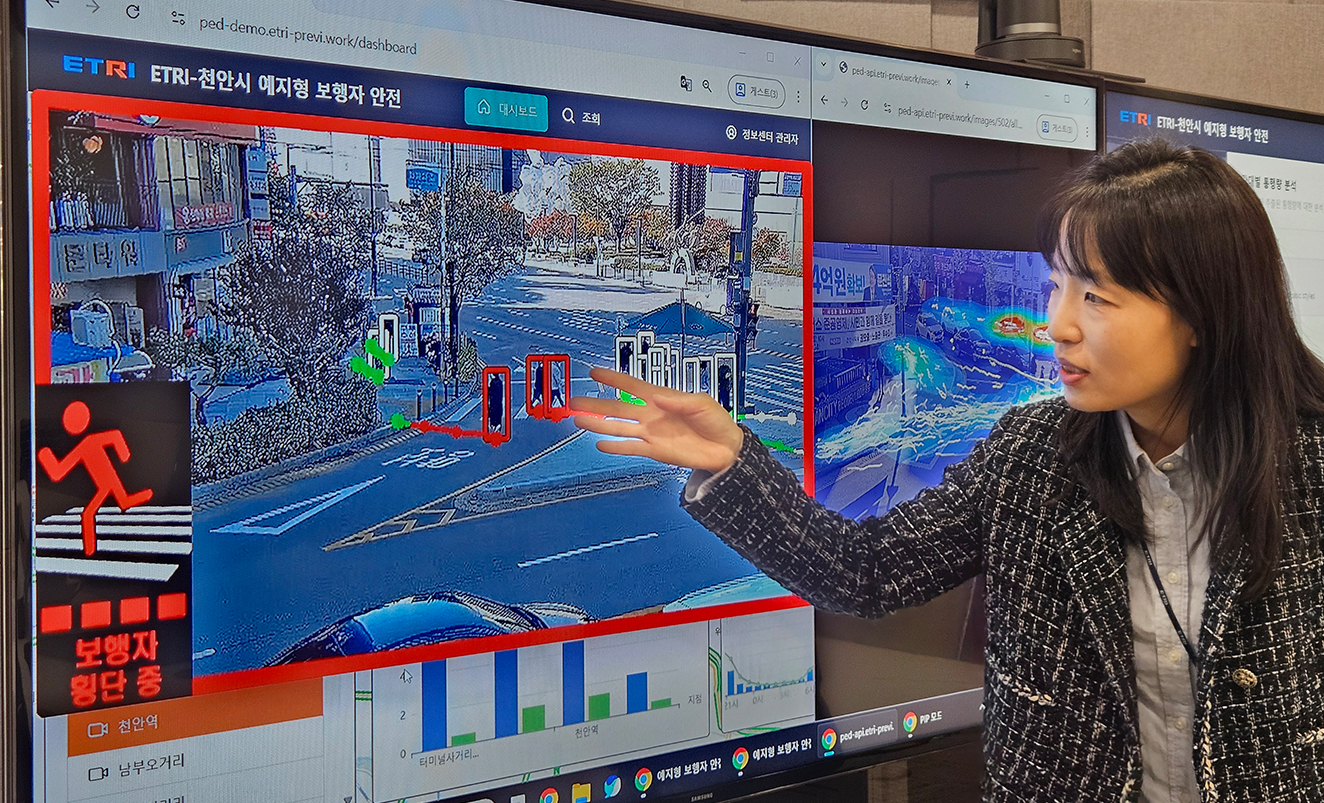
Korean researchers have developed key technology to ensure pedestrian safety at intersections, laying the foundation for a paradigm shift in traffic safety. This technology is expected to significantly reduce pedestrian accidents after being tested by local governments and commercialized in the future.
ETRI announced that since October 8, it has been conducting a demonstration of Korea’s first “predictive pedestrian safety AI service” at four major intersections in Cheonan. This service can predict pedestrian trajectories to prevent traffic accidents in advance.
This technology goes beyond existing safety systems that simply detect pedestrians, supporting the recognition of pedestrians who are about to cross but are not yet visible to the driver, and is being evaluated as a key technology opening a new paradigm in next-generation traffic safety.
The existing pedestrian alert systems distributed to local governments required manual setting of specific “detection zones” by humans. This system resulted in pedestrians passing nearby the zones to be perceived as hazards, triggering unnecessary alerts, and there was the inconvenience of having to update detection zones whenever new cameras were installed or their orientation changed. Above all, alerts were triggered only after pedestrians had already entered the road, leaving insufficient response times for drivers. And there were also cases where road sections outside the detection zones were incorrectly identified as safe.
The “predictive pedestrian safety service” developed by ETRI is a technology that preemptively recognizes and predicts the possibility of traffic accidents.
The system consists of on-site CCTV cameras, variable message signs that provide alerts to drivers, controllers, and remote video analysis servers. Based on footage captured by CCTV, the system automatically generates a ground region map within 2 seconds, identifying crosswalks and the entire roadway as risk areas. This allows for precise reflection of the actual traffic environment.
The system predicts pedestrian trajectories and can send risk alerts to drivers via variable message signs about 3 seconds before pedestrians enter the crosswalk. Based on the predicted pedestrian trajectories, the system evaluates the risk level and visually displays risk information (pedestrian safety images) on the variable message sign, graded from 0 to 4 (five levels total).
Since alerts are triggered only for pedestrians who will actually cross, unnecessary alerts can be reduced, and drivers can preemptively recognize pedestrians in blind spots when making right or left turns. Currently, this service is installed at four locations, including two near Cheonan Station with high foot traffic and two at Terminal Intersection, and is being demonstrated for right-turning vehicles.
In the future, ETRI plans to optimize and enhance the system with an edge-server hybrid structure linking on-site devices and central servers. On-site, edge devices analyze video to predict pedestrian risks, while the central server handles edge device control and statistical analysis.
Additionally, the system plans to gradually implement features such as predicting vehicle trajectories to provide pedestrians with alerts of approaching vehicles through directional speakers, and natural language-based traffic analysis Q&A.
This technology can expand beyond traffic safety to industrial safety sectors such as logistics centers, factories, and construction sites. It also predicts the trajectories of people and equipment, such as workers, forklifts, robots, and transport vehicles, identifies risky spots, proactively displays situations with a high risk of collision, and provides step-by-step risk alerts to provide more response times for managers. In addition, in a workplace where changes such as the relocation of materials occur frequently, it can automatically create work area maps and provide information tailored to the on-site situation, reduce unnecessary false alerts in various work conditions, and accurately select and send only the necessary alerts.
The core technology underpinning the success of this technology is receiving significant attention both domestically and internationally. The technology for anticipating vulnerable pedestrians was published in a renowned SCI(E) journal in the field of science and technology last May. In August, three papers on pedestrian situation classification and pedestrian trajectory prediction were presented at AVSS 2025, a globally prestigious academic conference, and received academic recognition.
The technology has been recognized for both its originality and commercial viability, leading to patent applications. ETRI has applied for international patents for this predictive pedestrian safety system in Korea as well as in the United States, China, and Europe.
Furthermore, it has applied for five domestic patents and three US patents for key technologies, including: ▲pedestrian situation classification technology based on automatic ground region map generation ▲pedestrian crossing intention prediction technology ▲pedestrian trajectory prediction technology.
Also, the researchers identified visual memory-based predictive visual intelligence technology as the core underlying technology behind these achievements. The visual memory-based predictive visual intelligence technology processes video input to abstract the visual information, storing and managing it in visual memory. Through integrated analysis, it accurately understands past relationships and current situations, enabling future predictions.
While the existing video analysis is limited to simply recognizing objects or actions appearing in the video, predictive visual intelligence technology is differentiated in that it can understand long-term context and even predict future situations by simulating human memory mechanisms that accumulate and recall visual information.
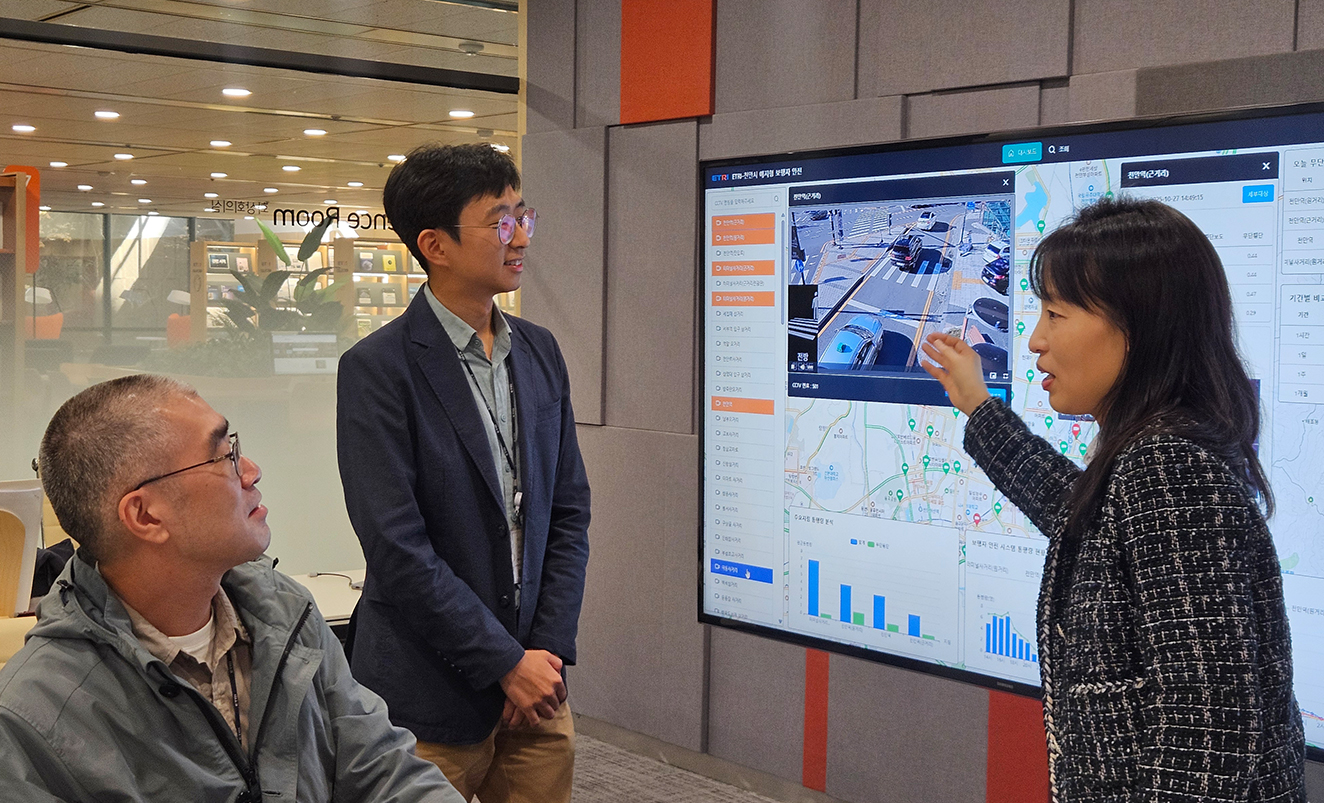
Jinyoung Moon, Principal Researcher of ETRI’s Visual Intelligence Research Section, said, “Through this on-site demonstration, we have proven a new traffic safety standard that ‘predicts the pedestrian trajectory and notifies the driver 3 seconds in advance.’ We have verified a safety system that automatically understands intersection conditions and proactively sends alerts. We will continue to cooperate with local governments to consistently enhance predictive traffic safety standards.”
Seok-pil Kim, Acting Mayor of Cheonan City (Vice Mayor), stated, “It is very meaningful that Korea’s first predictive safety AI technology for pedestrians begins practical operation in Cheonan. We expect that this service will contribute to preventing traffic accidents and creating a safe pedestrian environment for citizens. We will expand the demonstration to new downtown areas in the future, making Cheonan a safe transportation city.”
The research team plans to commercialize this technology by 2027 by transferring the technology to smart transportation solution-related companies. They also plan to discuss additional demonstration with local governments outside of Cheonan to expand the technology nationwide.
This research was conducted as part of the project titled “Development of Previsional Intelligence based on Long-term Visual Memory Network,” supported by the Institute of Information & Communications Technology Planning & Evaluation (IITP) grant funded by the Korea government (Ministry of Science and ICT).
The ETRI research team has achieved outstanding research results through this project, including ▲28 SCI-level papers, including those in the top 0.5% of SCI journals ▲19 top-tier academic conference papers, including 5 papers at CVPR, the world’s top academic conference ▲23 papers at excellent international academic conferences ▲55 domestic and international patent applications, 18 registered.
ETRI plans to expand the demonstration sites in conjunction with local government’s intelligent transportation systems and develop them into a nationwide pedestrian safety system. Furthermore, ETRI plans to expand predictive safety technology to various transportation facilities such as automobiles, trains, and bicycles, aiming for “zero traffic accidents” as its goal.
Jinyoung Moon, Principal Researcher
Visual Intelligence Research Section
(+82-42-860-6712, jymoon@etri.re.kr)


