ETRI Webzine


News
Vol.85 October
- Sweeps all events in multi-sensor-based object detection and tracking
- Proves domestic AI technology prowess... emerging as a core smart city technology
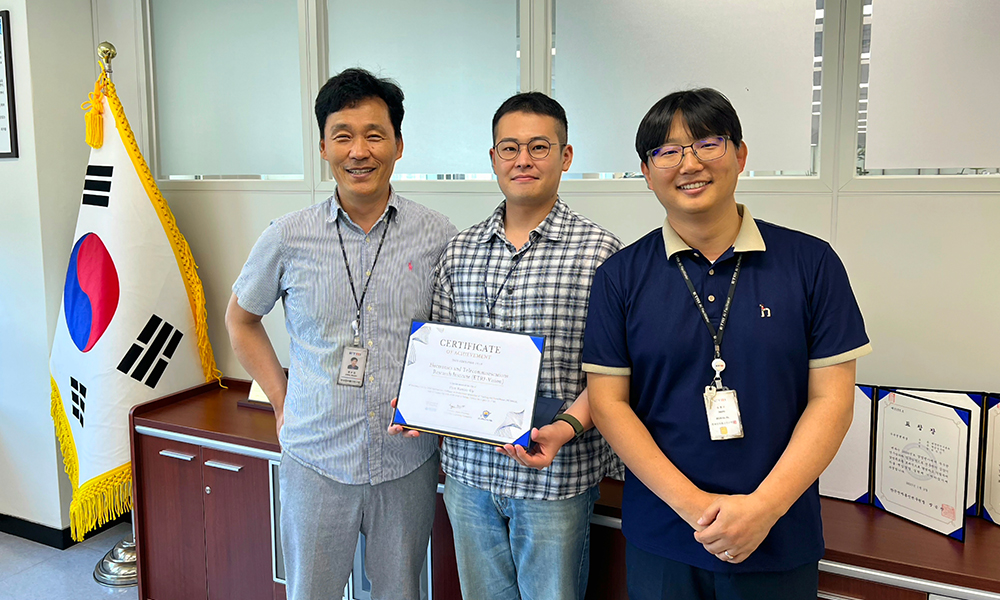
Korean researchers have won first place at the Performance Evaluation of Tracking and Surveillance (PETS) 2025 Challenge, the world’s largest international competition on intelligent surveillance hosted by IEEE International Conference on the Advanced Video and Signal-Based Surveillance (AVSS)1), held in Tainan, Taiwan for three days from August 11th.
Electronics and Telecommunications Research Institute (ETRI) demonstrated its world-class technological prowess by taking first place overall in all scenarios in the tracking track and second place overall in the detection track. This achievement is particularly significant as it was the only Korean research team to participate in the competition.
1) The Advanced Video and Signal-Based Surveillance (AVSS): IEEE International Conference on Advanced Video and Signal-based Surveillance.
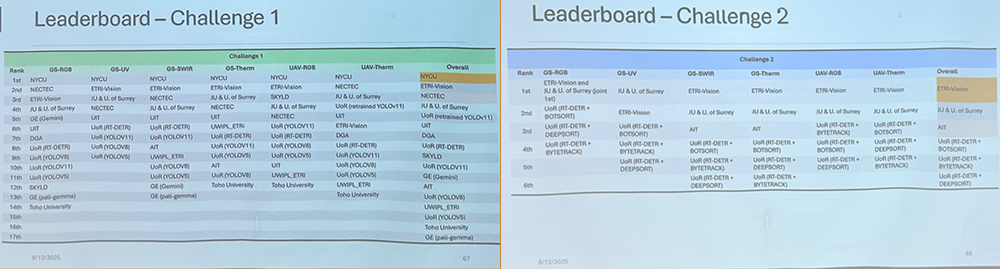 (Left) 2nd place overall in detection
The PETS 2025 competition is an intelligent surveillance technology assessment competition organized by the University of Reading, UK, and sponsored by the European Multi Authority Border Security Efficiency and Cooperation (EUMARS)2).
The competition evaluates the ability to recognize and track people, vehicles, and ships based on a variety of sensor types and imaging conditions, including trichromatic (RGB), thermal, short-wave infrared (SWIR), and ultraviolet (UV). It is characterized by presenting challenging conditions such as ▲ resolution mismatch between sensors, ▲ lighting and weather changes, and ▲ complex congestion as scenarios that reflect the actual surveillance environment.
2) European Multi Authority Border Security Efficiency and Cooperation (EUMARS): An advanced surveillance platform to improve the European Multi-Authority Border Security efficiency and cooperation (stylized as “EURopean Multi Authority bordeR Security”).
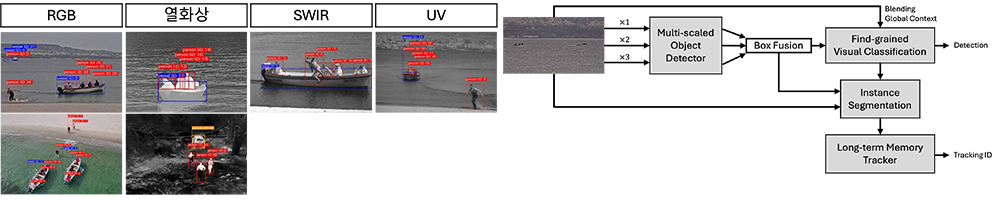 (Left) Multi-sensor video sample for intelligent surveillance
The competition was conducted online. Teams analyzed the provided video dataset and submitted their results, and the organizers automatically evaluated their performance using internationally standardized metrics such as MOTA, IDF1, and HOTA. The final results were then officially presented at the AVSS conference, and the researchers attended the awards ceremony in Tainan, Taiwan, on the 12th.
ETRI took first place in the tracking track, while the joint research team of Jiangnan University in China and the University of Surrey in the UK took second place. In the detection track, National Yang Ming Chiao Tung University in Taiwan was ranked first and ETRI was ranked second, demonstrating the highest level of global competitiveness.
ETRI researchers implemented an AI-based system that integrates the entire process of image recognition, detection, and tracking, and maintained high accuracy even in complex environments. In particular, their effectiveness was recognized, demonstrating stable performance even under challenging conditions frequently encountered in real-world surveillance systems, such as ▲ small objects, ▲ resolution variances between sensors, and ▲ frame misses.
This achievement is the result of inheriting and developing smart city intelligent traffic control and video analysis technology know-how accumulated through national R&D projects over the past 30 years and object tracking algorithms developed by senior researchers.
The researchers expect the technology to be applied to various fields such as ▲ urban traffic surveillance, ▲ port security, and ▲ maritime surveillance in the future. It is also attracting attention as a core foundation technology for next-generation smart city surveillance systems because it works stably even in the face of variables such as weather and lighting changes.
ETRI is promoting technology transfer discussions with domestic security and video solution companies, smart city platform operators, and port and maritime surveillance system manufacturers with the goal of commercializing the technology in 2027.
Once commercialized, it is expected to contribute significantly to improving public safety and city operation efficiency, including ▲ early detection of traffic accidents, ▲ optimization of traffic flow, ▲ monitoring of illegal vessels, and ▲ early response to maritime distress and pollution accidents.
Researchers Kim Sangwon, Kim Dongyoung, Lee Kyoungoh, and Kim Kwangju from the ETRI Daegu-Gyeongbuk Research Division participated in this competition and were responsible for technology development and system construction. In particular, master’s degree researcher Kim Dongyoung presented Pixel-Level Fire Origin Localization via Digital Twin Mapping for Wildfire Surveillance Framework at the AVSS plenary session, which attracted great interest from related researchers.
Byun Woo Jin, Vice President of ETRI Daegu-Gyeongbuk Research Division, said, “This achievement demonstrates the excellence of our technology, which operates reliably under a variety of lighting, weather, distance, object size, and obstacle environments. We will continue to strengthen our demonstration-focused research and development to contribute to public safety and create social value.”
Kim Sangwon, Researcher
AI Infrastructure Research Section
(+82-53-670-8025, eddiekim@etri.re.kr)
- Sound source location delay technology included in Final Draft of immersive audio International Standards
- Realization of immersive 3D audio, providing realistic sound technology
- Expectations for evolution in Metaverse and VR audio... expanding auditory experiences into virtual environments
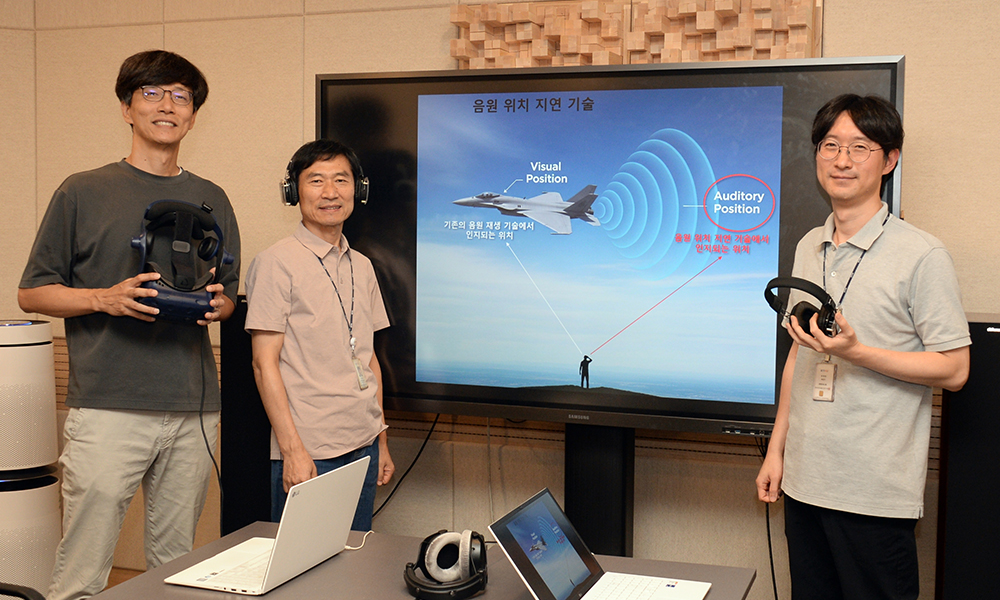
Korean researchers have achieved a remarkable result in the international standardization organization that develops digital video and audio compression standards.
Electronics and Telecommunications Research Institute (ETRI) announced that the ‘sound source location delay technology’ developed by its researchers was officially reflected in the final draft of the MPEG-I immersive audio standard, an international standard1) for immersive audio by MPEG (Moving Picture Experts Group)2), in April.
This achievement means that the core audio technology has, in effect, been adopted as an international standard, marking an important milestone in which domestic researchers lead the international standards in the field of realistic audio.
ETRI researchers have been directly involved in the development of the SW as well as editing the standards documentation. A separate item for the corresponding signal processing has also been created and is being driven towards international standardization. Furthermore, the researchers also disclosed that a total of 12 international standard patents have been adopted, including methods and devices for compensating delayed location according to the distance of the sound source.
ETRI’s ‘sound source location delay technology3)’ is a technology that precisely reproduces the phenomenon in which sounds that move quickly, such as fighter jets, or occur at a distance, such as thunder and lightning, are heard slightly delayed from their actual location.
1) MPEG-I Immersive Audio: MPEG audio technology standardization that aims to standardize immersive realistic sound rendering technology for 6DoF spatial sound services that allow free movement and interaction of the listener, and metadata encoding required for rendering.
2) Moving Picture Experts Group (MPEG): An international standardization organization that develops compression standards for digital video and audio; founded in 1988, it is a working group under the International Standards Committee called ISO/IEC JTC 1/SC 29.
3) Sound Source Location Delay Technology: A technology that accurately and realistically implements the phenomenon where a sound from a rapidly moving or distant sound source is heard at a delayed location or time compared to the visually perceived location. This technology had not been reflected in the field of virtual environment audio until now, and through its use, more realistic and superior acoustics can be provided in VR, the Metaverse, remote education, virtual conferencing, gaming, and realistic performances.
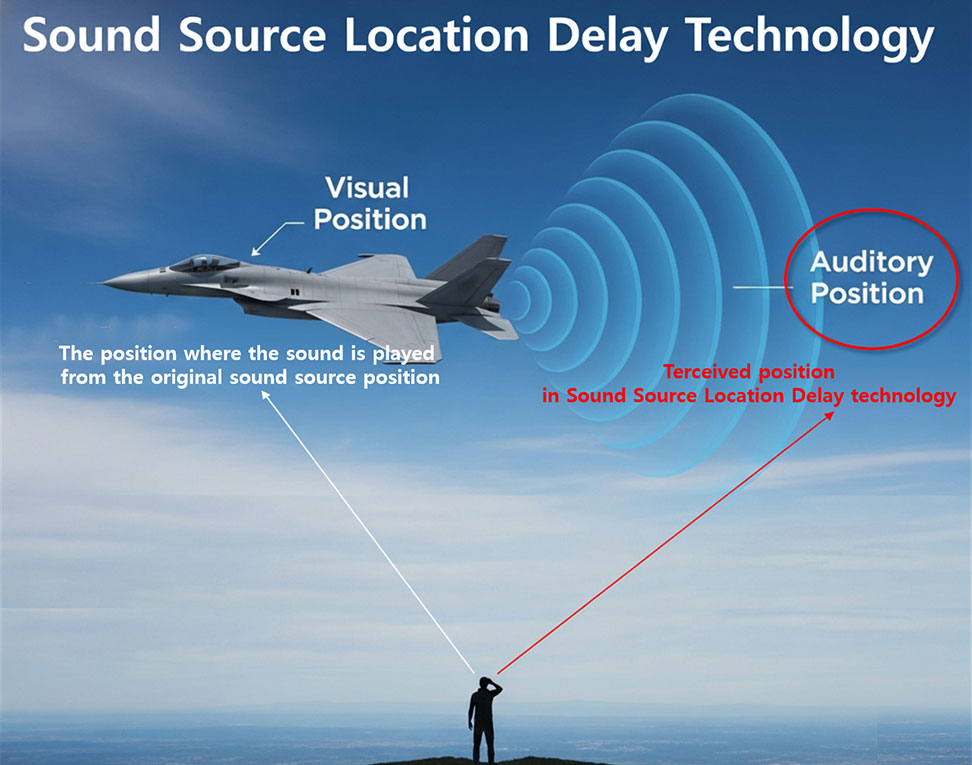 Overview of Sound Source Location Delay Technology
In the real world, the time difference between when a sound is generated and when it is heard is naturally perceived, known as auditory time lag, but existing virtual audio technologies do not reflect the auditory time lag factor, which leads to a lack of realism and immersion.
ETRI has overcome these technical limitations and implemented time-based auditory perception elements even in virtual environments, enabling a more natural and realistic 3D audio experience. This newly developed technology is the world’s first to capture even this auditory time lag.
‘MPEG-I immersive audio’ is an MPEG audio technology standardization that aims to standardize immersive realistic sound rendering technology for 6DoF spatial sound services that allow free movement and interaction of the listener, and metadata encoding required for rendering.
ETRI’s ‘sound source location delay technology,’ which compensates for the effects of sound source location delay for fast-moving and distant sound sources, adds time-based auditory elements to this standard, dramatically enhancing the sense of immersion. Through this, the standard can be utilized as a key element in fields that require precise reality simulation, such as VR experiences, training, and education.
This technology, which will serve as a next-generation audio technology where 3D spatial audio reacts in real-time to changes in the user’s viewpoint, is expected to be widely used in various industries, including immersive Virtual Reality (VR), the Metaverse, virtual conferencing, remote education, gaming, and realistic performances. This is projected to elevate the international status of South Korea’s realistic media technology and lead the next-generation audio market. Furthermore, it is expected to greatly contribute to strengthening the competitiveness of related industries.
Jung Won Kang, Director of ETRI’s Media Coding Research Section, stated, “This achievement is significant not only because it’s a simple technical proposal, but also because our technology has been recognized as a key component in establishing international standards. We will continue to focus on securing audio technology that can lead the world in the immersive media field and on international standardization efforts.”
Taejin Lee, Assistant Vice President of ETRI’s Media Research Division, also commented, “Until now, the immersive audio standard primarily focused on spatial elements such as sound direction and distance expression, while the time-based perceptual element, which is critical for actual auditory perception, has been overlooked in standardization discussions. The reflection of this technology is an achievement recognized not as a simple feature addition, but as a core component of establishing the international standard” Based on this technology, ETRI plans to lead the way in ultra-realistic stereoscopic media technology by ▲ developing dynamic stereoscopic media acquisition/generation and real-time content interaction technologies, and ▲ working on low-latency, high-quality simultaneous sound compression and international standardization. Furthermore, to realize ultra-realistic two-way stereoscopic communication, ETRI plans to focus on ▲ real-time spatial content generation technologies and ▲ developing and demonstrating core spatial interaction technologies (PoC).
This research was conducted as part of the research operation support project of ETRI as a research task titled “The research of the basic media/contents technologies”
Jae-hyoun Yoo, Principal Researcher
Media Coding Research Section
(+82-42-860-1556, jh0079@etri.re.kr)
- Launching ISO standards for ‘Red Team Testing’ and ‘Trustworthiness Label’ to identify potential AI risks
- Leap to become a first mover in global rulemaking... realizing Sovereign AI and AI G3 in earnest
- Red Team Challenge and Workshop to be held at Novotel Dongdaemun on the 4th and 5th of next month... Applications accepted until the 22nd
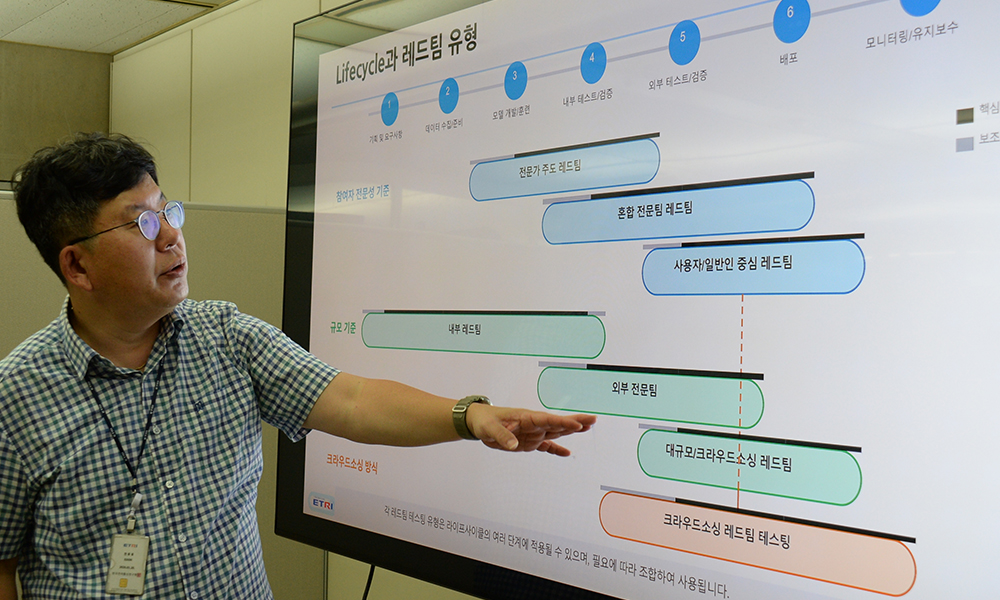
As artificial intelligence (AI) technology rapidly pervades our lives and industries, ensuring its safety and trustworthiness is a global challenge. In this context, Korean researchers are gaining traction by leading the development of two key international standards.
Electronics and Telecommunications Research Institute (ETRI) announced that it has proposed the “AI Red Team Testing” standard, which aims to proactively identify risks in AI systems, and the “Trustworthiness Fact Label (TFL)” standard, which aims to help consumers easily understand the authenticity level of AI, to the International Organization for Standardization (ISO/IEC) and has begun full-scale development.
With this, Korea has elevated its status beyond being a mere “fast follower” of technology to a “first mover,” setting the rules for the AI era.
‘AI Red Team Testing1)’ is a method of aggressively exploring and testing how secure an AI system is. For example, it proactively identifies situations where generative AI may produce incorrect information or be exploited to circumvent user protections.
1) AI Red Team Testing: Exploratory and aggressive testing methods that intentionally try different attacks and test the limits of a system to identify potential vulnerabilities, harmful or biased results, security issues, etc. in an AI system. It aims to proactively detect real-world threats and strengthen the defense system.
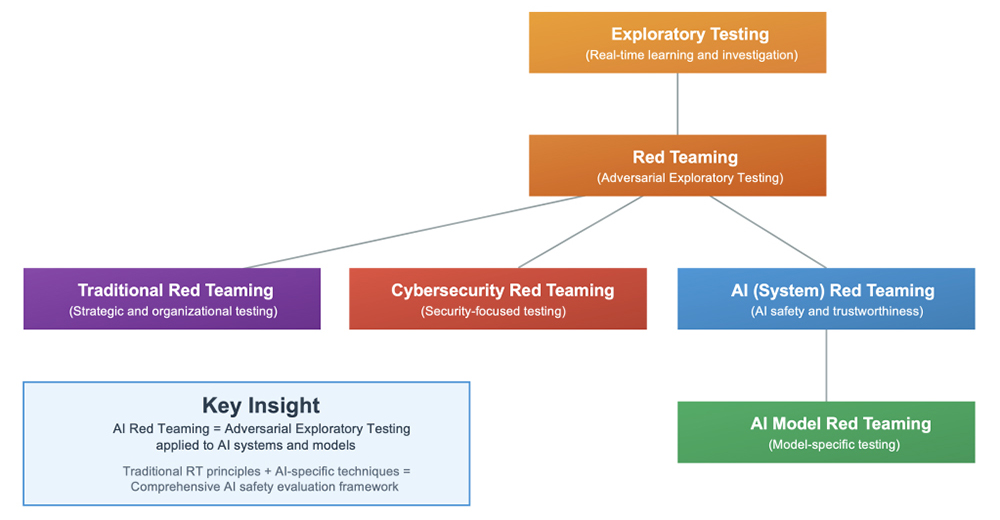 Concept Diagram of Software Testing and AI Red Team Testing
ETRI serves as the editor of ISO/IEC 42119-7, the international standard2) in this field, creating common international test procedures and methods that can be applied across a wide range of fields, including medicine, finance, and national defense.
Meanwhile, ETRI, together with the Ministry of Food and Drug Safety, has hosted the first ‘Advanced AI Digital Medical Product Red Team Challenge and Technology Workshop’ in Korea at the Novotel Seoul Dongdaemun Hotel on September 4th and 5th. This challenge was the first event of its kind in Asia and Korea for advanced AI medical devices, where medical professionals, security experts, and the general public will participate to examine the biases and risks of AI.
ETRI is also developing a medical-specific red team evaluation methodology in collaboration with Seoul Asan Medical Center, and will create a red team test system for digital medical products that applies advanced AI technology and conduct empirical testing. In addition, it has formed a council with major companies such as STA, NAVER, Upstage, SelectStar, KT, and LG AI Research Institute to strengthen cooperation on international AI red team standardization.
Another key standard is Trustworthiness Fact Labels (TFLs)3).
2) ISO/IEC 42119-7 (Red teaming): The first common international standard for AI red teams that defines terminology, procedures, and methods for AI red team testing. Development of the standard began in April 2025, and is currently underway, with a target date of December 2027. (Editor: Jeon Jong Hong, Principal Researcher of ETRI)
3) Trustworthiness Fact Labels (TFLs): A label that provides information about the trustworthiness of an AI system in a standardized format that is easy for consumers to understand, much like a nutrition label on a food product. It includes test results for various trustworthiness criteria, including AI robustness, fairness, and explainability.
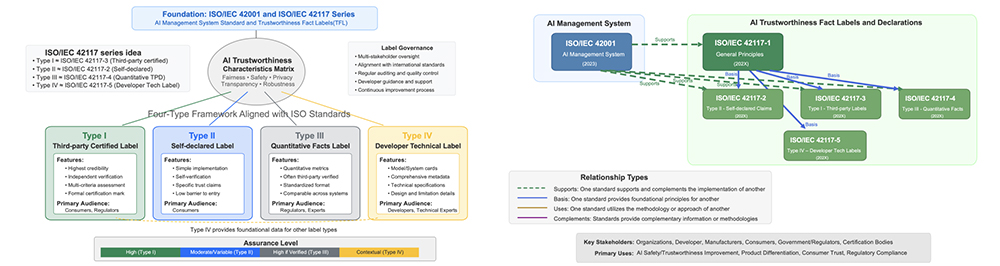 (Left) Types and Contents of Trustworthy Fact Label (TFL), and Target Applications
The label is an at-a-glance visualization of how trustworthy an AI system is, providing transparent information to consumers, much like a nutrition label on a food product.
ETRI is leading the development of the ISO/IEC 421174) series of standards, which can be operationalized in a variety of ways, with companies providing the information themselves or having it verified and certified by a third-party organization.
In the future, ETRI is even considering incorporating ESG factors, such as AI’s carbon footprint.
In conjunction with the AI Management System Standard (ISO/IEC 42001)5), which is used as an international certification standard for organizations using AI, the standard will serve as a framework to demonstrate how trustworthy the developed products and services are.
These two standards align with the government’s Sovereign AI6) and AI G3 leapfrog strategies. This is evaluated as an example that goes beyond simply securing technological prowess and makes a practical contribution to the competition for leadership in creating global AI rules.
Just as the National Institute of Standards and Technology (NIST) in the United States supports national and international standardization to realize the national AI strategy, ETRI envisions supporting the realization of the national AI strategy by developing AI security technologies and leading international standardization of AI safety and trustworthiness, including the activities of the AI Safety Research Institute.
Kim Wook, PM of the Institute of Information & Communications Technology Planning & Evaluation (IITP), said, “Providing AI safety and trustworthiness will make it easier for everyone to use AI, and leading the way in international standards this time is a turning point toward becoming a country that leads AI norms.”
Lee Seung Yun, Assistant Vice President of ETRI’s Standards & Open Source Research Division, also said, “AI red team testing and trustworthiness labels are key technical elements included in AI regulatory policies in the U.S., EU, and other countries, and these international standards will serve as common criteria for evaluating the safety and trustworthiness of AI systems around the world. ETRI will continue to lead international standardization in the field of AI safety and trustworthiness, making Korea the center of excellence for not only Sovereign AI but also Sovereign AI safety technologies.”
This achievement was made through the “Development of Advanced Artificial Intelligence Safety and Trustworthiness Testing and Evaluation Technology Standards” project supported by the Ministry of Science and ICT and the Institute of Information & Communications Technology Planning & Evaluation (IITP), and the “Development and Verification of Generative AI Digital Medical Product Red Team Testing and Evaluation Technology” project of the Ministry of Food and Drug Safety Consortium.
4) ISO/IEC 42117 (Trustworthiness Fact Labels): An international standard that defines the principles of trustworthiness fact labels, the type of label declaration (self-declaration, third-party verification, etc.), and the method of verification. Development began in April 2024, and a series of four standards is scheduled to be published by 2028. (Editor: Jeon Jong Hong, Principal Researcher of ETRI)
5) ISO/IEC 42001 (AI Management System. AIMS): The world's first AI management system standard, defining a structured framework and requirements for organizations to design, operate, and monitor AI systems responsibly and ethically. Applicable to any organization that develops, delivers, or uses AI. Certification is performed by an external auditor and is valid for three years, followed by annual monitoring and recertification.
6) Sovereign AI: Technological sovereignty, where a country can secure its own AI technology, data, and infrastructure, and develop and control AI without being dependent on external sources and in accordance with its own values and norms.
Jeon Jong Hong, Principal Researcher
Intelligence & Information Standards Research Section
(+82-42-860-5333, hollobit@etri.re.kr)


