ETRI Webzine


ETRI Completes First Real-World Verification of Maritime IoT Communications Network
Vol.85 October
- Simultaneous connection of up to 30 devices over a distance of up to 35km, enabling maritime safety and environmental monitoring
- Establishment of a maritime IoT communication network in the West and South Seas utilizing the 3GPP NB-IoT standard

Korean researchers have successfully verified the world’s first real-world maritime Internet of Things (MIoT)1) communication network, which collects marine data by installing sensors and communication devices on ships, ports, and marine facilities and can be used for safety management and environmental monitoring.
Electronics and Telecommunications Research Institute (ETRI) announced that it has built an MIoT communication network in the waters of the West and South Seas, realizing a communication distance of up to 35km and simultaneous connection of 30 devices. This achievement is significant as it marks the first time that IoT international standard technology2), defined by the 3rd Generation Partnership Project (3GPP)3), has been tested and verified in an actual ocean environment.
The MIoT communication network developed can be utilized to build a big data system that collects marine weather, ecological, and environmental data and shares it with public institutions. It can also contribute to the efficient operation of maritime facilities such as AtoN (Aids to Navigation), fishing gear, aquaculture facilities, and uninhabited island management. It can also be used for public safety management, such as tracking small boats, life jackets, and marine floating matters, which has a wide range of applications.
1) Maritime IoT (MIoT): A technology that collects, transmits, and analyzes various data related to the sea by attaching sensors and communication devices to navigation aids, ships, ports, and maritime facilities to increase the value of the maritime industry, including safety management, efficient operations, and marine environmental monitoring.
2) 3GPP Rel.16 NB-IoT technology: NB-IoT evolutionary technology, finalized as an international standard in 2020, is a 3GPP international standard IoT technology that improves low-power, long-range communication performance and supports satellite interworking, enabling reliable IoT data transmission even in large areas such as oceans.
3) The 3rd Generation Partnership Project (3GPP): A collaborative research project council formed to create specifications for telecommunications systems beyond the scope of the International Telecommunication Union’s IMT-2000 project, from third generation (3G) to 4G, 5G, and 6G.
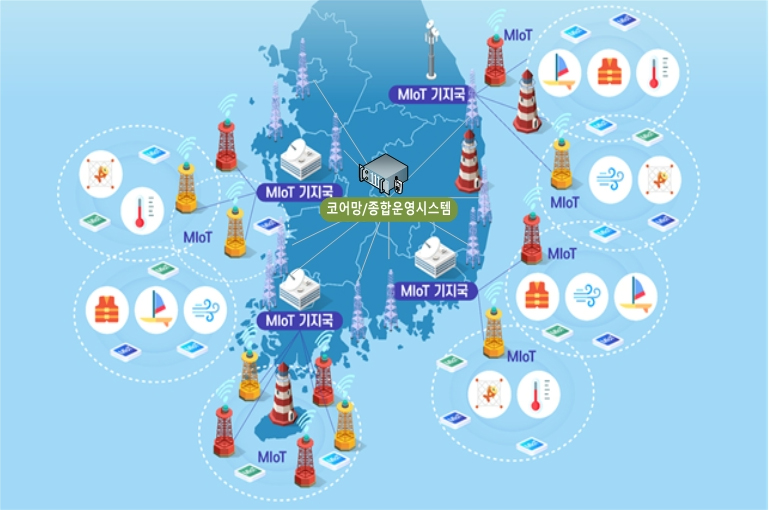 Marine Internet of Things (MIoT) network concept diagram
The researchers developed an independent network that links base stations, terminals, core networks, and application services by utilizing the 450MHz band public dedicated frequency4) secured by the Ministry of Oceans and Fisheries in 2023. In June, they installed a base station at Odongdo Lighthouse in Yeosu and placed 30 terminals at six locations, including test light buoys, successfully transmitting and receiving actual data. In August, they continued their communication demonstrations by establishing a base station at Maldo Lighthouse in Gunsan and placing terminals at lighthouses in Gunsan Port, Bieung Port, Janghang Port, and Gyeokpo Port.
4) Public dedicated frequencies (450MHz band, 200kHz each up and down): In 2023, the Ministry of Oceans and Fisheries applied to the Ministry of Science and ICT for public frequency use for 2024. The need for a maritime Internet of Things (IoT) network was recognized, and 200 kHz each up and down was designated in the nationwide LTE Band 31.
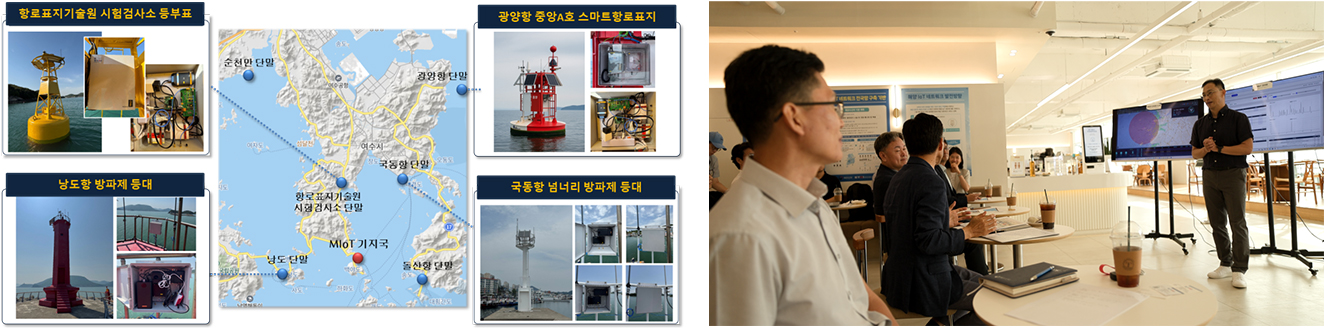 (Left) Maritime IoT terminals with Yeosu area AtoNs
As a result, 27km communication between Odongdo base station and Nangdo port terminal and 35km communication between Malo base station and Janghang port terminal were successfully achieved.
Once connected to the network, the placed devices performed reliably, transmitting GPS location, light status, shock detection, and battery level every three minutes. In addition, 30 devices installed at AtoNs (Aids to Navigation), in Yeosu and Gunsan succeeded in connecting simultaneously, and commercial test equipment verified that up to 1,000 devices can connect simultaneously.
Based on this achievement, ETRI plans to build an MIoT pilot network in the three regions of the East, West, and South Seas starting in 2026, and expand to the entire country after 2030.
The MIoT system developed by ETRI is built as an independent network, unlike the existing land-based narrow band Internet of Things (NB-IoT)5), and applies low-power transmission and reception technology optimized for the maritime environment and message prioritization for safety services.
Unlike LTE-M (LTE-Maritime)6), which specializes in transmitting large amounts of data, this is a communication network tailored for low-power and low-cost devices, and it is differentiated in that it can be complemented with existing maritime communication networks to realize a dense maritime network similar to that on land.
The International Organization for Marine Aids to Navigation (IALA) has already begun work on international standardization of maritime IoT technology, and the government has established the ‘3rd Basic Plan for Navigational Aids to Navigation (2025~2029)’ and the ‘Marine Navigation Information System Innovation Strategy (2025.4)’ to promote the establishment of a nationwide maritime IoT communication network.
ETRI’s achievements this time are expected to contribute not only to responding to international standardization but also to attracting the ‘International Cooperation Center for Navigational Aids’ to Korea and exporting overseas technologies.
Dr. Cho Seong Chul, the project leader for this research, said, “The world’s first verification of an MIoT communication network in the actual ocean is not just a technology demonstration, but also a foundation for the creation of new industries based on maritime big data and the expansion of national maritime safety infrastructure. We will strive to lead Korea’s global maritime digital transformation by building pilot networks in the East, West, and South Seas and further advancing our technology in line with international standards.”
Lee Moon Sik, Assistant vice president of the Satellite Communication Research Division, said, “Securing a public frequency to implement a standalone maritime IoT network in the actual ocean and demonstrating a maritime IoT communication network based on smart navigation aids is a first in Korea and an unprecedented achievement internationally. It is expected to further enhance Korea’s maritime safety management and climate crisis response capabilities.”
This research was conducted as part of the “The advancement of smart aids to navigation facilities (’21~’25)” project, jointly supported by the Ministry of Oceans and Fisheries and the Korea Institute of Marine Science & Technology Promotion. The National Maritime PNT Office, the Korea Institute of Aids to Navigation, domestic telecommunication companies, and research institutes participated together, and ETRI completed the verification of the actual sea area function of the Rel. 16 NB-IoT system. ETRI plans to continue system advancement and commercialization verification through further research.
This achievement is expected to lay the foundation for Korea to lead the global maritime IoT market while simultaneously securing maritime big data and strengthening maritime safety.
5) Narrow band Internet of Things (NB-IoT): NB-IoT, short for Narrow Band-IoT, is a wireless communication technology optimized for Internet of Things (IoT) devices that need to transmit small amounts of data and maintain long battery life with low power.
6) LTE-M (LTE-Maritime) technology: A maritime LTE network that provides e-Nav services such as automatic updates of electronic charts, real-time route guidance, and hazard warnings by establishing an LTE-based high-speed wireless communication network in the coastal area up to 100km away as the core communication base for the Korean e-Navigation project.
Cho Seong Chul, Principal Researcher
Spatial Wireless Networking Research Section
(+82-42-860-5682, sccho@etri.re.kr)


