

Vol.89
June
KOR
NEWS

ETRI’s Top News

NEWS 1
ETRI Develops “Forgetfulness-Free AI” Technology...AI That Does Not Forget Even After Learning New Knowledge

- Adopted at “NeurIPS 2025,” the World’s Most Prestigious Artificial Intelligence (AI) Conference
- Solves Multimodal AI’s “Catastrophic Forgetting” Problem... Knowledge Editing Performance Improved by More Than Double
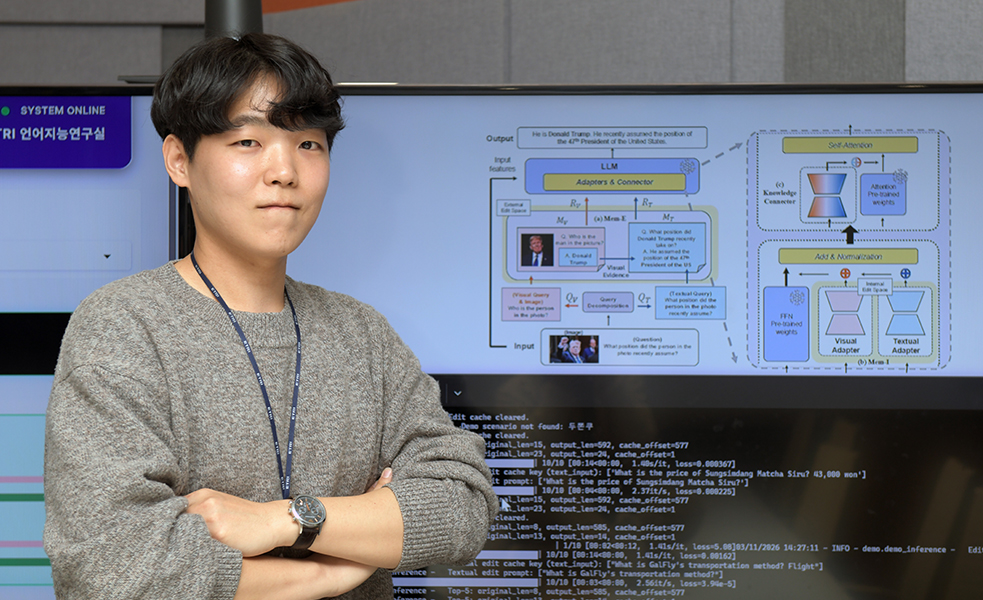
Korean researchers have developed a core source technology that allows multimodal1)Multimodal: A technology in which artificial intelligence simultaneously learns and, through integration, processes various forms of data (modalities), such as text, images, speech, and video, to perceive like humans. artificial intelligence (AI) to reliably retain existing knowledge without losing it even when repeatedly learning new knowledge, attracting global attention.

Electronics and Telecommunications Research Institute (ETRI) announced that the “Continual and Compositional Knowledge Editing Technology (MemEIC),2)Continual and Compositional Knowledge Editing Technology (MemEIC): An AI model update technology that enables multimodal AI to reliably retain previously learned knowledge without losing it even as the AI continues to learn new knowledge.” jointly developed by the research team led by Director Lim Soo Jong of the Language Intelligence Research Section with Pohang University of Science and Technology and Sungkyunkwan University, was presented at NeurIPS3)NeurIPS: Neural Information Processing Systems, held every December, is the world's largest and most prestigious academic conference on artificial intelligence (AI) and machine learning. 2025, the world’s most prestigious AI conference, and held in San Diego, U.S., late last year.

Recently, multimodal AI that can understand images and text simultaneously, such as ChatGPT, Gemini, and Claude, has been spreading rapidly. For example, it is AI that can look at a photo and describe it or answer when asked in text about what is in an image.

However, this type of AI had one major problem. When AI learns new information or revises existing information, a phenomenon called “catastrophic forgetting4)Catastrophic Forgetting: Refers to the phenomenon in which artificial neural networks (deep learning models) rapidly or completely lose previously acquired knowledge or capabilities when learning new information.” occurs, in which it forgets previously learned knowledge as well. In other words, when AI learns something new, it develops a kind of “AI forgetfulness” in which it forgets what it previously knew.

In particular, when visual information and language information had to be revised at the same time, the two types of knowledge often became mixed together, causing the AI to misunderstand and frequently give wrong answers to compositional questions.

For example, if an AI is sequentially taught the visual information, “The dessert shown in the photo is Dubai chewy cookie (Dujjonku),” and the language information, “Dujjonku is popular in Korea,” and is then asked, “In which country is this dessert popular?”, existing AI models showed limitations in properly connecting the photo with the relevant knowledge.

In such cases, existing models frequently produced hallucinations, such as misidentifying the dessert in the photo and generating inaccurate answers such as, “The image shown in the photo is a chocolate truffle and is popular in Europe.”

To solve this problem, ETRI researchers developed a knowledge-editing AI technology capable of accurately answering even compositional questions.

Conventional methods mainly used an approach that changed knowledge by directly modifying the AI’s internal parameters5)Parameter: The internal values that an AI model automatically adjusts during training to convert inputs into outputs.. This was a kind of “brain-surgery-like approach” that fundamentally altered the structure of the existing model, and it was limited in that even previously stored information could be affected in the process of modifying knowledge.

Instead, the researchers proposed a method of storing new information in external memory rather than inside the AI. This approach of adding an auxiliary memory has a structure that retrieves and uses information only when needed, making it possible to flexibly add new information while maintaining the stability of the existing model, thereby ensuring scalability as well.

MemEIC was designed with inspiration from the structure of the human brain. Just as the human brain is divided into the left and right hemispheres, which play different roles, the AI was designed to store knowledge separately as well.

Image-related visual information is stored independently in a “visual adapter,” while text-related language information is stored independently in a “language adapter.” Then, when the AI receives a compositional question that requires understanding both images and text, a “knowledge connector” links the two pieces of information according to context to produce an answer.

It was confirmed that AI applying the MemEIC technology developed by ETRI accurately combined visual and language information and correctly answered, “The dessert shown in the photo is Dubai chewy cookie (Dujjonku), and it is popular in Korea.”

In this way, through a separated-storage and selective-combination structure that stores knowledge separately and connects it only when needed, an AI architecture capable of compositional reasoning and answering compositional questions was implemented by minimizing the problems of internal interference, in which different information becomes mixed, and the degradation of existing knowledge.

To verify the technology’s performance, the researchers built a compositional knowledge editing benchmark6)Benchmark: A test that uses standardized data and evaluation criteria to objectively compare and assess the performance of hardware or software such as computers, smartphones, and AI models. (CCKEB) consisting of 1,278 items and conducted experiments that sequentially edited hundreds of pieces of knowledge. As a result, MemEIC achieved an accuracy level of approximately 70% in answering compositional questions. Compared with the 36% to 52% range of existing technologies, this represents more than double the performance. In addition, the preservation characteristic of “locality,7)Locality: A metric that evaluates how much internal knowledge an AI model retains after a new knowledge update.” in which response stability is maintained because answers to existing questions do not change even after new knowledge is added, was also confirmed.

This study is highly meaningful in that it goes a step beyond merely alleviating AI’s forgetting phenomenon and simultaneously solves the two challenges of continuous knowledge editing and compositional reasoning. In particular, it is expected to have high practical applicability in intelligent service fields that require continual updates as new information is constantly added and changed, such as policy and legal information, product information, and industrial data.

Director Lim Soo Jong of ETRI’s Language Intelligence Research Section said, “This study is an achievement that has laid the technological foundation for multimodal AI to simultaneously reflect up-to-date information required in real service environments and secure reliability. We will further advance the technology so that it can reliably reflect diverse information from industrial sites in the future.”

Seong Jin, the first author of the paper and a researcher at ETRI’s Language Intelligence Research Section, explained, “Conventional methods had the problem of interference occurring while revising visual knowledge and language knowledge at the same time. MemEIC overcame these limitations through a structure that stores the two types of knowledge independently and connects them only when needed.”

This study was conducted as part of the “Development of Learning and Utilization Technologies for the Sustainability of Generative Language Models and the Reflection of Up-to-Dateness Over Time” project under the “Next-Generation Generative AI Technology Development Program” supported by the Ministry of Science and ICT and the Institute of Information & Communications Technology Planning & Evaluation (IITP).

Seong Jin, Researcher
Language Intelligence Research Section
(+82-42-860-6147, real_castle@etri.re.kr)
NEWS 2
ETRI Develops Korea’s First 200Gbps Photodetector

- Data Processing Capacity per Channel Doubles...5 Full HD Movies per Second
- Domestic Development of Optical Device Technology to Address the “Data Explosion” in AI and Cloud
- Rear-Lens Integrated Structure Expected to Improve Light-Reception Efficiency and Reduce Costs

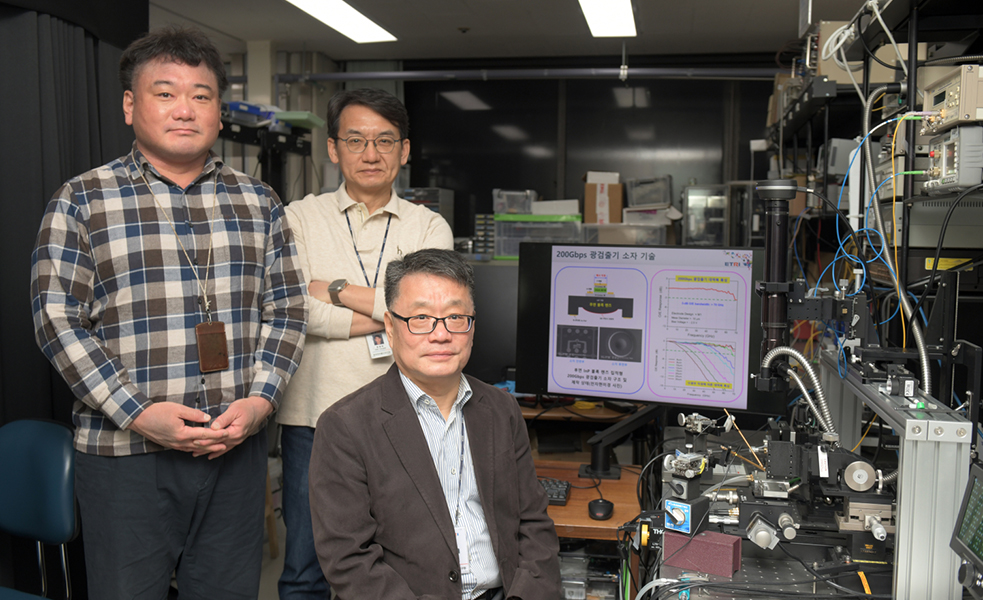
Korean researchers have developed, for the first time in Korea, a 200Gbps-class photodetector device1)Photodetector Device: A semiconductor device that converts optical (light) signals into electrical signals. A key component that determines the speed and sensitivity of receivers in data centers and communication networks. that can be used in hyperscale AI data centers and 5G/6G mobile communications infrastructure. This technology enables ultrahigh-speed data reception at a level capable of transmitting five 5GB full HD movies per second.

Electronics and Telecommunications Research Institute (ETRI) announced that it has developed a photodetector device capable of processing 200Gbps-class optical signals per channel. A photodetector is a key semiconductor component that converts optical signals into electrical signals and is an essential element that determines data reception performance in data centers and communication networks.

The photodetector device developed by the researchers simultaneously achieved a bandwidth of 70GHz or higher and high responsivity of 0.75A/W or greater, and measures 0.5mm × 0.4mm. In particular, by applying a “rear-lens integrated structure” that monolithically integrates a convex lens2)Convex Lens: A three-dimensional lens structure designed to facilitate light reception and alignment of photodetector devices. made of indium phosphide (InP)3)Indium Phosphide: A compound semiconductor material made of indium (In) and phosphorus (P). A material used in high-speed, high-frequency optical devices and communications semiconductors. on the back of the chip, optical reception efficiency and alignment convenience have been significantly improved. It is also meaningful that the entire process, from design to fabrication, was implemented using purely domestic technology.

The device is expected to be applied in the receiver section of optical transceivers4)Optical Transceiver: An optical communications module that transmits and receives by converting electrical signals into optical signals and vice versa. A device used for high-speed data transmission between data centers and telecommunications equipment. for internal AI data center networks in the future. In data center tower racks5)Tower Rack (Equipment Rack): A rack structure used to vertically mount and operate servers, switches, power supplies, and other equipment. A facility designed to improve equipment density and cabling/cooling efficiency., linecards6)Linecard: An interface board installed in network equipment such as switches and routers. A module that performs data transmission/reception and packet processing through ports and optical modules. carry many optical transceivers, making the performance and cost efficiency of key components important.

ETRI’s rear-lens integrated structure does not require separate light-receiving lens7)Light-Receiving Lens (Receiving Lens): A lens that collects light emitted from the light source (where light is generated) of an optical transceiver, reflected from or transmitted through an object, and delivers it to a photodetector (sensor). components, which can simplify packaging and is expected to reduce costs when manufacturing 800Gbps and 1.6Tbps optical modules.

Photodetectors device widely used in data centers typically offer data rates of about 112Gbps per channel. Through this technology development, ETRI made it possible to process optical signals of up to 224Gbps per channel, improving data processing capacity by about two times compared with existing levels.

With the recent spread of AI, cloud, OTT, virtual reality (VR), and augmented reality (AR) services driving a surge in data traffic, the importance of securing ultrahigh-speed, high-capacity optical device technology is growing even more.

200Gbps-class photodetector chips are a highly advanced technology that only a small number of companies worldwide can develop. Based on indium gallium arsenide (InGaAs)8)Indium Gallium Arsenide (InGaAs): An optoelectronic material with high photosensitivity and fast response characteristics in the near-infrared (NIR) and short-wave infrared (SWIR) ranges (approx. 900~1700nm). A key material used in receiver devices for high-speed optical communications, such as photodetectors. photodetector technology and experience in operating a compound semiconductor9)Compound semiconductor: A semiconductor material made by combining two or more elements. A semiconductor used in communications, optical devices, and power semiconductors because it has superior high-frequency, high-power, and optical characteristics compared to silicon. foundry, ETRI succeeded in securing core source technologies.

This is expected to reduce reliance on foreign suppliers and strengthen the competitiveness of Korea’s optical device and components industry. In addition, the monolithic rear-lens integrated structure is expected to help secure price competitiveness in the next-generation 800Gbps and 1.6Tbps optical module market.

Kwon Yong Hwan, Assistant Vice President of ETRI’s Photonic/Wireless Devices Research Division, said, “By developing, for the first time in Korea, core photodetector device technology applicable to the fast-growing AI data center and 5G/6G markets, we are now able to contribute to strengthening the competitiveness of Korea’s optical components industry.”

Han Young Tak, Principal Researcher at ETRI’s Optical Communication Components Research Section, also explained, “The key to this achievement was securing both core source technologies and stable foundry operation capabilities in the field of compound opto-semiconductors, which is highly sensitive to process variables.”

ETRI has filed domestic and international patents related to this technology and completed the transfer of the technology to Wooriro Co., Ltd., a Korean optical components company. It plans to actively support industrial application and commercialization so that it can compete with global companies in the future AI data center and 5G/6G communications markets.

According to market research firm LightCounting, the global optical transceiver market is projected to grow more than threefold, from USD 6 billion in 2019 to USD 18 billion in 2026.

The results of this study were presented at OECC10)OECC (OptoElectronics and Communication Conference): An academic conference and exhibition related to optical communications, held annually in the Asia-Pacific region under the auspices of the host country's optical society, IEEE, and OPTICA. 2025, the largest optical communications conference in the Asia-Pacific region held in Sapporo, Japan, and were recently published in the prestigious international journal Optics Express11)Optics Express: An international academic journal on optics and photonics published by OPTICA, and an open-access journal that rapidly publishes the latest research achievements across optical technologies, including optical communications, lasers, and optical devices..

This research was conducted through the “Development of Optical Device Component Technology for 1.6Tbps Optical Transceivers for Intra-DC Communications” project supported by the Ministry of Science and ICT and the Institute of Information & Communications Technology Planning & Evaluation (IITP).

Han Young Tak, Principal Researcher
Optical Communication Components Research Section
(+82-42-860-5067, frenclin@etri.re.kr)

NEWS 3
ETRI Develops “Hierarchical AI Agent”...That Tackles Complex Errands with Ease

- Developed “ReAcTree,” Which Autonomously Breaks Down and Plans Complex Tasks
- Doubles the Success Rate of Existing Models and Secures Large-Model-Level Performance with a Small Model

Korean researchers have developed a hierarchical AI technology that autonomously plans even complex long-horizon tasks. The development of this hierarchical task-planning AI technology, which reduces hallucinations and doubles the success rate, is expected to help robots and agents carry out long-term missions.

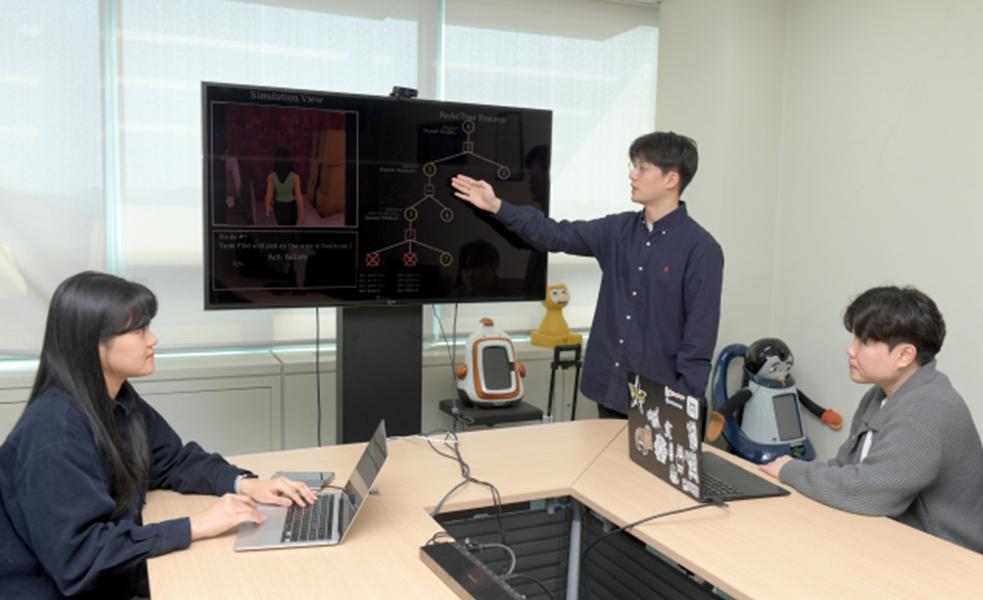
Electronics and Telecommunications Research Institute (ETRI) developed the hierarchical task-planning artificial intelligence (AI) technology “ReAcTree1)ReAcTree: An AI agent technology that hierarchically processes complex long-horizon tasks by having AI itself divide them into subgoals.”, which autonomously divides tasks requiring complex and lengthy procedures into subgoals and carries them out, and presented it at AAMAS 20262)AAMAS 2026: International Conference on Autonomous Agents and Multiagent Systems, the most prestigious academic conference in the field of autonomous agents and multiagent systems. An event in which researchers from related academia and industry gather to exchange the latest technologies and research trends., one of the world’s premier conferences in the AI agent field.

This research achievement is regarded as an important technological advance that enables Large Language Models (LLM)3)Large Language Model (LLM): An AI model that learns from vast amounts of text data to understand language like a human and perform dialogue, summarization, translation, and more. to move beyond simply generating text, allowing robots and virtual agents to perform complex real-life tasks more reliably.

Recently, although large language models have shown excellent language understanding and reasoning capabilities, they still have limitations in performing long-horizon tasks4)Long-Horizon Task: A task that can only be completed through multiple steps of logical planning or action (e.g.: organizing the kitchen, cooking, etc.). in which multiple steps proceed sequentially, such as cooking or cleaning. Existing approaches processed all procedures as one long flow, so as the steps became longer, the phenomenon of “hallucination5)Hallucination: A phenomenon in which an AI model (especially a large language model, LLM) generates incorrect information plausibly and confidently as if it were true.”—forgetting earlier instructions or taking irrelevant actions—occurred frequently.

To solve this problem, ETRI researchers developed ReAcTree by introducing “Hierarchical Agent Trees6)Hierarchical Agent Trees: An architecture that organizes the roles and execution order of multiple AI agents into a tree-shaped hierarchical structure to solve complex tasks.”. This structure is similar to a corporate organizational chart. In this approach, a top-level agent manages the overall goal and assigns detailed tasks to lower-level agents.

For example, when given the command, “Cook potato slices and put them in the refrigerator,” ReAcTree does not process it all at once. Instead, it breaks the goal down into tasks such as “find a kitchen knife,” “find and cut the potatoes,” “heat the cut potatoes in the microwave,” and “store them in the refrigerator,” and then has each lower-level agent perform its assigned role. Whereas conventional AI frequently makes logical errors, such as skipping the step of heating the potatoes midway, ReAcTree completes it successfully. In addition, when searching for an object, it autonomously generates subgoals to search each room sequentially, enabling it to find the target with high probability.

To enhance the agent’s execution capabilities, the researchers combined two memory systems. One is “episodic memory7)Episodic Memory: A long-term memory system that stores specific experiences of an AI agent successfully performing tasks and references them later when solving similar problems.”, which stores past successful experiences and uses them in similar situations, and the other is “working memory8)Working Memory: A memory system that allows AI agents to share observed information and retrieve it when needed.”, through which all agents share current environmental information.

For example, the information “There is juice in the refrigerator” is immediately shared among all agents through working memory, while previously successful search methods are reused through episodic memory. Through this, the agent’s judgment and execution accuracy were greatly improved.

The technology’s performance was validated on ALFRED and WAH-NL, virtual household-environment datasets, based on “LoTA-Bench9)LoTa-Bench: Language-oriented Task Benchmarking (LoTa-Bench) is an evaluation framework developed by ETRI research team to automatically evaluate the performance of language-centered procedural generation artificial intelligence (AI).”, ETRI’s self-developed language-centered procedural-generation AI benchmark. As a result of evaluating it in a visibility-limited environment that reflects realistic conditions, it achieved a world-class task success rate. In particular, while the conventional method (ReAct) using a 72 billion (72B)10)72 billion (72B) parameters: Refers to a language model containing approximately 72 billion trainable parameters. parameter language model recorded a 31% task success rate, ReAcTree achieved a 61% success rate, showing nearly a twofold performance improvement.

In particular, when ReAcTree was applied to a small language model with 7 billion (7B) parameters, it recorded a higher success rate (37%) than the conventional method using a large 72 billion (72B)-parameter model. This result shows that performance comparable to large models can be achieved with relatively fewer computing resources, and is regarded as an achievement that greatly improves technological operating efficiency.

Kim Do Hyung, Director of ETRI’s Social Robotics Research Section, said, “ReAcTree is a technology that logically deconstructs complex procedures and can respond flexibly even in uncertain environments through collaboration among agents,” adding, “Going forward, we plan to further reduce hallucinations and upgrade it to a level applicable in real life by adding a function that allows agents to resolve uncertainty by asking people questions.”

This research was carried out as part of the projects on “Development of Complex Task Planning Technologies for Autonomous Agents” and “Development of Uncertainty-Aware Agents Learning by Asking Questions,” supported by the Ministry of Science and ICT and Institute of Information & Communications Technology Planning & Evaluation (IITP).

Choi Jae Woo, Senior Researcher
Social Robotics Research Section
(+82-42-860-1303, jwchoi0717@etri.re.kr)