

FOCUS ON ICT
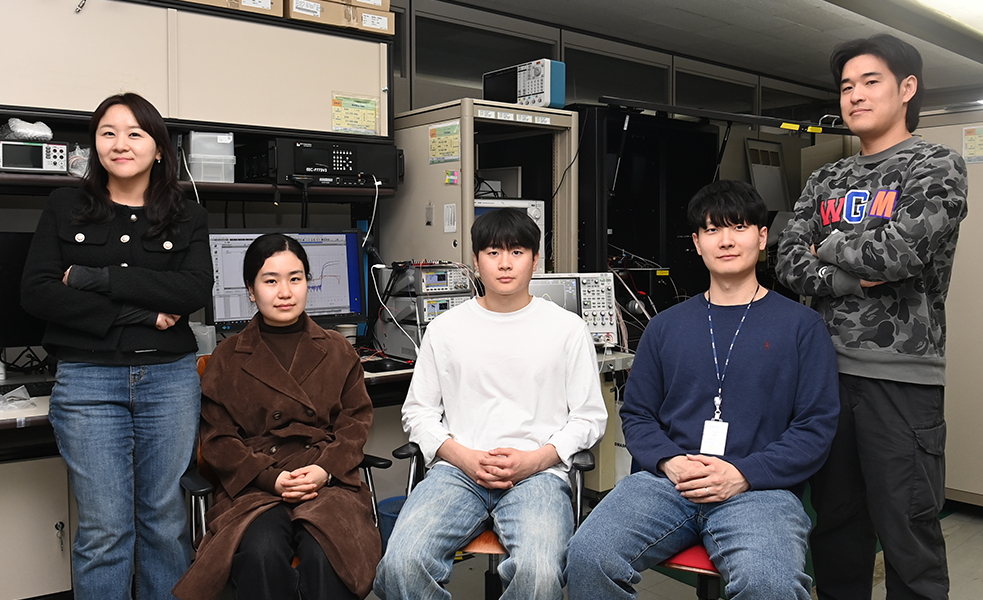
Korean researchers have demonstrated a breakthrough that opens new possibilities for, and goes beyond the limitations of, low-power, high-density memory technology needed in the next-generation artificial intelligence (AI) era. They have implemented an innovative next-generation memory (DRAM)1)DRAM (Dynamic Random Access Memory): A high-speed volatile memory that temporarily stores data and applications in use on computers or smartphones. structure that overcomes the limitations of conventional memory with complex structures and can reliably store data without a separate capacitor2)Capacitor: A passive electronic component that temporarily stores and releases electricity using an insulator placed between two conductive plates..
Electronics and Telecommunications Research Institute (ETRI) announced that it has developed a ‘2T0C(2-Transistor-0-Capacitor)3)2T0C (2-Transistor-0-Capacitor): A next-generation memory technology structure that removes the capacitor, the core component for storing data in conventional DRAM, and configures a memory cell using only two transistors.’ DRAM structure that stores data without a capacitor by applying oxide semiconductor transistors (TFTs) used in the display industry. This research result was published in the March 3 online edition4)Published online on March 3: https://advanced.onlinelibrary.wiley.com/doi/epdf/10.1002/advs.202523540 of the world-renowned journal Advanced Science.
This technology is a next-generation memory approach called ‘capacitor-less DRAM5)Capacitor-less DRAM Technology (Capacitor-less DRAM, or 2T-DRAM): A next-generation memory technology that eliminates the data-storage capacitor, a core element of conventional DRAM, and stores and controls data using only a single transistor.’ that is considered to have presented a new direction for memory technology, which is becoming increasingly important as the era of AI and data-centric computing gets underway. This is because it could serve as an alternative that overcomes the structural limitations of conventional silicon-based DRAM.
Most commercially available DRAM currently uses a 1T1C structure6)1T1C Structure: The most basic circuit structure of DRAM (Dynamic Random Access Memory), in which one transistor and one capacitor are combined to form a single memory cell., in which one transistor and one capacitor operate together to store data. In this case, the capacitor acts as a small storage space that holds electrical charge. However, as semiconductors continue to shrink, it becomes increasingly difficult to fabricate these capacitors, while the manufacturing process becomes more complex and power consumption also increases.
For this reason, a new memory structure without capacitors was needed, but previous research had problems related to the difficulty of retaining data for long periods or poor stability.
To solve these problems, the researchers focused on a material called ‘oxide semiconductor.’ Oxide semiconductors have characteristics suitable for memory devices because they have low leakage current7)Leakage Current: A minute current that escapes through ground, the enclosure, or other paths outside the normal path of an electrical circuit due to imperfect insulation or equipment damage., the amount of electricity that leaks out, and can reliably maintain charge.
ETRI fabricated transistors using aluminum-doped indium-tin-zinc oxide (Al:ITZO)8)Al:IZTO (Aluminum-doped Indium-Tin-Zinc Oxide): A ternary amorphous oxide semiconductor material, indium-tin-zinc oxide, composed of indium (In), tin (Sn), zinc (Zn), and oxygen (O). and precisely controlled internal defects through a nitrous oxide (N2O) plasma process. Through this, it succeeded in reducing internal defects in the device and effectively suppressing leakage current. In addition, it was designed so that stored charge would not easily dissipate by optimizing the channel ratio (W/L) of the read transistor9)W/L: A key design ratio that determines transistor performance (current flow). Width/length ratio of the channel size..
As a result, data could be retained for more than 1,000 seconds, and the memory window10)Memory Window: The margin range within which data can be accurately distinguished., the range in which data can be clearly distinguished as ‘0’ and ‘1,’ also improved by about 13 times. This means data can be stored longer and more accurately, and it is regarded as a key achievement that simultaneously improved the two indicators considered core performance metrics in 2T0C DRAM, thereby increasing the feasibility of practical memory applications.
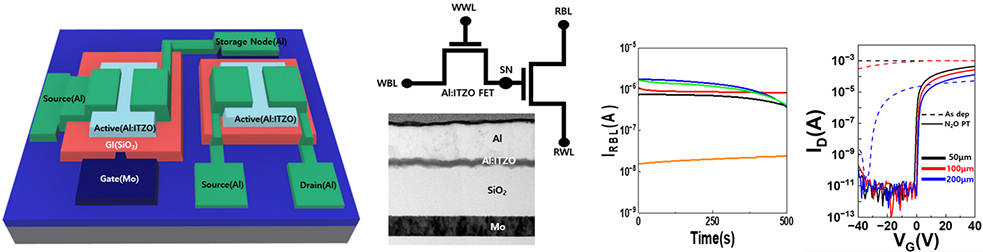 Structure and operating characteristics of oxide semiconductor-based capacitor-less 2T0C DRAM devices
In particular, this study differs from previous research in that it not only stores data for longer periods but also improves the stability with which the memory operates.
Nam Sooji, Principal Researcher of ETRI’s Flexible Electronics Research Section, said, “We confirmed that oxide semiconductor technology developed in the display field can also be applied to next-generation memory devices. It is expected to play an important role in future 3D semiconductor integration technology and low-power computing systems.”
This study is significant in that it suggests the potential of new memory technology beyond the structural limitations of conventional silicon-based DRAM technology. In particular, it is expected to become an important turning point in securing high-density, low-power memory technology needed for the AI era.
Meanwhile, in this study, Yang Cha Hwan, a master’s student at the ETRI campus of the University of Science and Technology (UST), participated as the first author, and ETRI’s Principal Researcher Nam Sooji participated as the corresponding author. It was also carried out with support from the Ministry of Trade, Industry and Energy’s project on “Inorganic Light-Emitting Display Technology Development” and ETRI’s “New Concept Preliminary Research Program.” The research team secured full-cycle technologies ranging from oxide semiconductor material development and process technology to circuit design and panel verification, laying the groundwork for next-generation semiconductor technology.
Nam Sooji, Principal Researcher
Flexible Electronics Research Section
(+82-42-860-1479, sjnam15@etri.re.kr)