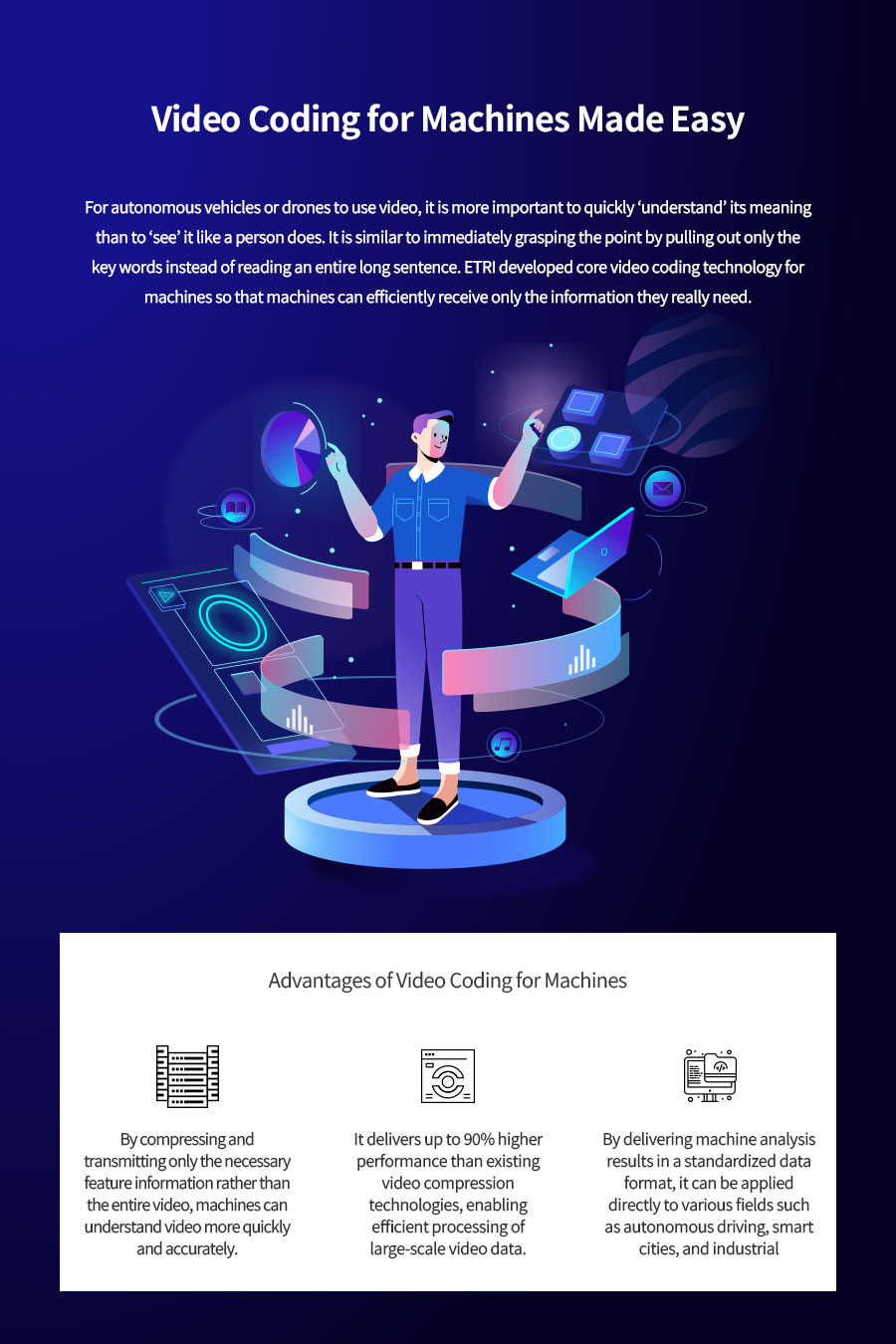

Beyond Humans,
Video Technology for Machines
Video Coding for Machines (VCM) Technology
Ultra-high-definition video and lifelike colors had long been the goal of media technology. However, now that AI and IoT have become part of everyday life, humans are no longer the only main consumers of video. Cameras in autonomous vehicles, drones, and smart cities must understand video rather than simply view it. ETRI developed core video coding technology for machines to understand video and carry out tasks without human intervention.
The Main Consumer of Video Has Changed
The media environment is changing rapidly. Video has now gone beyond content for people to watch and become data for machines to analyze and make decisions. With advances in AI technology and the spread of IoT devices, machine-to-machine video traffic has surged, and existing human-centric video compression technology alone has become inadequate to handle it.
In particular, in environments such as autonomous driving, intelligent video surveillance, and industrial automation, object, motion, and feature information matters more than the full video itself. In other words, what is needed is not quality-oriented video transmission, but a way to efficiently deliver only the information that machines can understand. From this awareness of the problem, a new concept called ‘video coding for machines’ emerged.
Video Coding Technology Redesigned for Machines
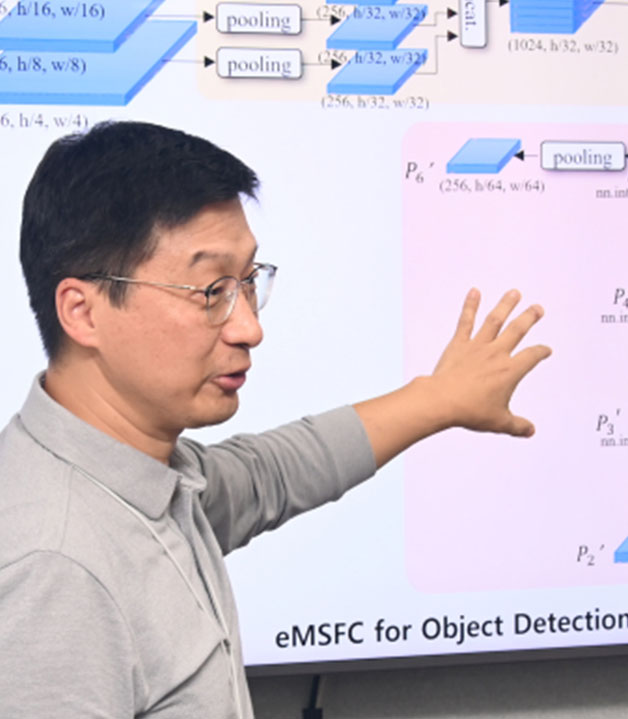
ETRI researchers developed three core technologies for machine-centric video environments. First is AI-based video feature compression coding technology. By using neural networks to extract and compress only the necessary features from video, it achieved top-tier results in MPEG international standard comparative evaluations, recording a performance improvement of more than 92% over conventional VVC (Versatile Video Coding).
Second is video transformation and processing technology for machine vision video coding. By coding video around regions of interest and flexibly adjusting the spatial resolution according to object distribution, the technology reduced unnecessary data transmission. This technology also showed about 36% better performance than VVC in MPEG core experiments.
Lastly, through machine vision coding technology based on video feature descriptors, the research team implemented a data format that efficiently represents the analysis and recognition results produced by machines. This technology was adopted as an MPEG IoMT standard proposal, proving its potential as an international standard technology.
From International Standards to the Industrial Field
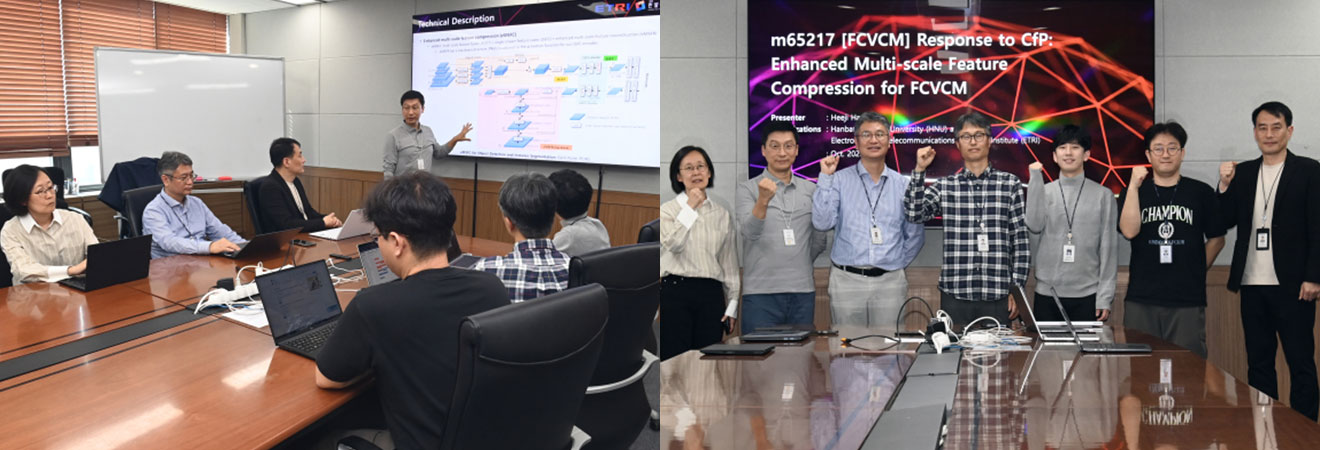
This achievement did not remain at the research level, but proved its competitiveness on the international stage. At MPEG standardization meetings, the technology recorded world-leading performance through comparative technology evaluations against global companies, and it established technical credibility through the adoption of numerous standard proposals and the acquisition of patents.
This technology can be applied across a wide range of fields, including autonomous vehicles, smart cities, drones, industrial automation, and video security. In particular, by transmitting only the feature information needed for machine task execution rather than the original video, it reduces the burden on communication bandwidth and fundamentally lowers the possibility of privacy violations caused by video capture.
From media for people to media for machines, ETRI's video coding technology is becoming the foundation of a new media ecosystem in a hyper-connected society, where machines understand and cooperate with one another.